
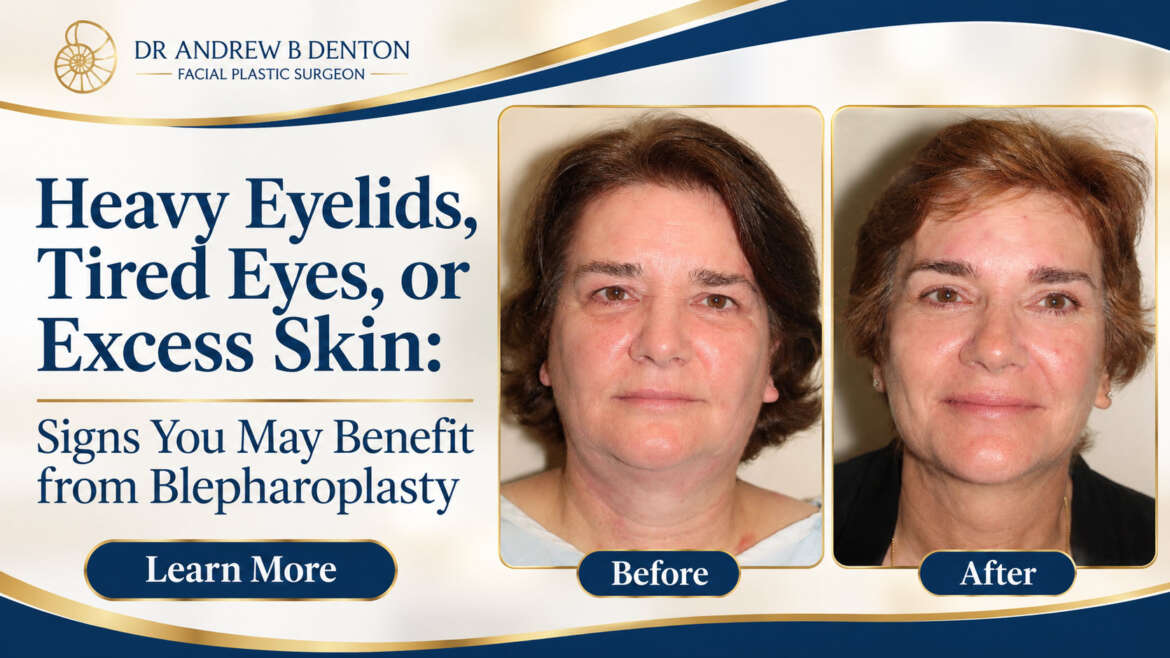
Your eyes serve as the focal point of your face, communicating your energy, attentiveness, and emotions during every personal and professional interaction. However, when the delicate tissues surrounding your eye sockets begin to sag, wrinkle, or form heavy folds, your face can convey an impression that does not match your internal vitality. Individuals across Vancouver, Burnaby, and Richmond notice that colleagues and friends frequently ask if they feel tired, stressed, or sad, even after a full night of restful sleep.
Facial ageing often manifests around the eyelids earlier than in other regions of the head and neck. The skin of the upper and lower eyelids is exceptionally thin, making it vulnerable to gravitational shifts, progressive collagen loss, and the weakening of internal retaining membranes. Over time, droopy upper eyelid skin can fold over the lash line, while displaced fat cushions create persistent bags beneath the eyes.
If you are evaluating options to refresh your eye area, understanding the primary benefits of blepharoplasty represents a critical first step. Surgical eyelid rejuvenation, clinically termed blepharoplasty, removes surplus skin, sculpts bulging fat deposits, and tightens underlying support structures. As a board-certified facial plastic surgeon in Vancouver with over twenty-five years of experience dedicated strictly to head and neck procedures, Dr Denton designs every treatment to yield well-proportioned, authentic outcomes that preserve your unique facial identity.
Understanding Periocular Ageing: Why the Eyes Age First
To appreciate why eyelid surgery is so effective, it helps to examine the underlying anatomical changes that occur around the orbital socket as the years pass.
The skin surrounding the human eye contains fewer oil glands and lacks the thick subcutaneous fat layer found across the cheeks or jawline. Beneath this delicate surface sits the orbicularis oculi muscle, which controls eye closure, and a connective tissue barrier known as the orbital septum. The orbital septum functions as a retaining wall, keeping the protective fat cushions that encircle the eyeball securely in position.
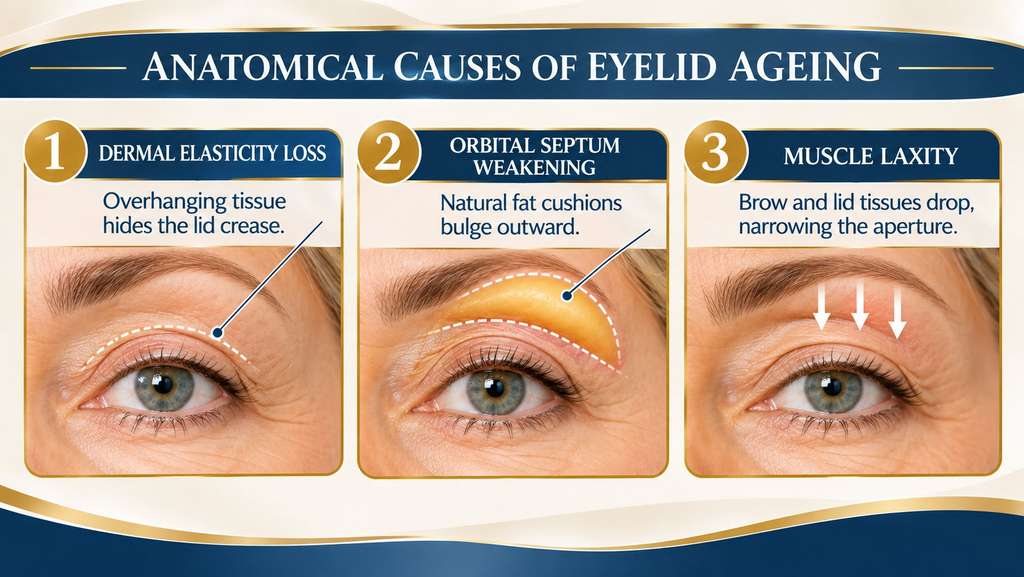
With advancing age and environmental exposure, three distinct anatomical shifts occur:
- Loss of Dermal Elasticity: Collagen depletion causes upper eyelid skin to stretch and drop downward, creating an extra skin fold that hangs over the upper lid crease. In advanced cases, this tissue rests directly on the eyelashes.
- Structural Membrane Weakening: As the thin orbital septum loses structural firmness, internal fat deposits bulge forward. This produces puffy swellings near the inner corners of the upper lids and bags across the lower eyelids.
- Orbicularis Muscle Laxity: The underlying muscle fibres thin out and loosen, contributing to surface wrinkling and a loss of crisp tissue definition along the orbital rim.
Because these structural shifts take place beneath the surface, topical creams, serums, and cold compresses cannot reposition internal fat or eliminate stretched skin. Surgical intervention directly addresses the anatomical root cause.
Recognizing the Key Signs: Do You Need Eyelid Rejuvenation?
Prospective patients frequently ask how to determine whether non-surgical skin care is sufficient or if surgical eyelid rejuvenation offers a better solution. Evaluating specific physical signs helps clarify whether an eyelid lift aligns with your goals, ensuring that you understand the full benefits of blepharoplasty before making a decision.
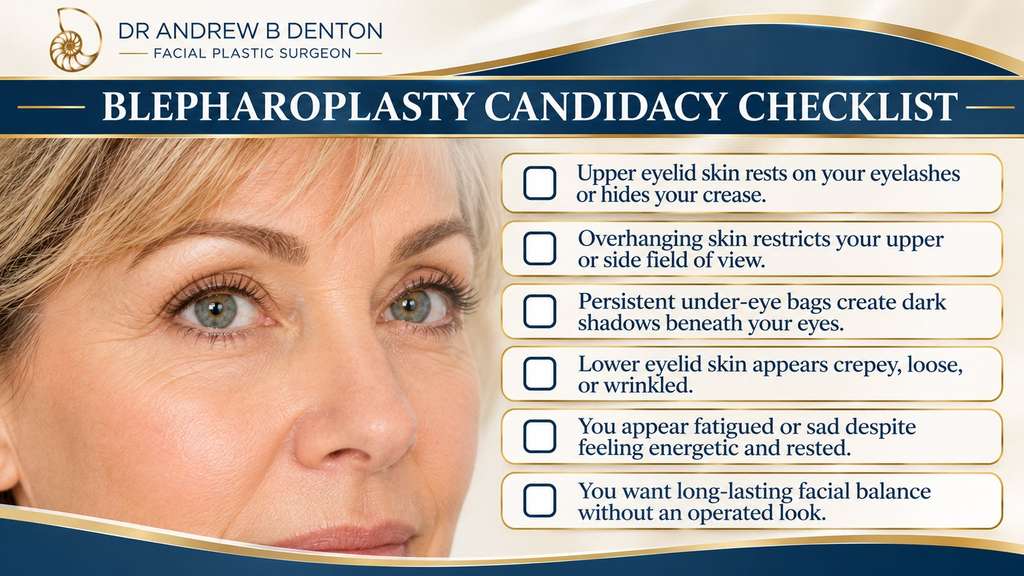
Sign 1: Heavy Upper Lid Skin Hiding the Natural Crease
When excess skin accumulates along the upper lid, the natural fold or crease becomes obscured. You may find that applying eye makeup becomes difficult because skin folds over itself, causing eyeliner or shadow to smudge quickly.
Sign 2: Vision Restriction Caused by Hooded Tissue
In more advanced stages, droopy upper eyelid skin hangs low enough to block your upper and peripheral fields of vision. You might catch yourself unconsciously lifting your eyebrows or tilting your head backward to read, drive, or view a computer screen.
Sign 3: Bulging Under-Eye Bags and Puffy Hollows
Puffiness under the eyes is often caused by displaced orbital fat rather than fluid retention. These fat deposits create distinct bulges that cast dark shadows across the lower lids, producing an exhausted expression that remains unchanged regardless of sleep quality.
Sign 4: Mismatched Facial Energy
If your face projects fatigue or sternness while you feel healthy and motivated, this emotional mismatch can affect your personal and professional interactions. Rebalancing your eye contours helps your outward appearance reflect your inner vitality.
Exploring the Types of Blepharoplasty: Customized Surgical Care
A successful treatment plan begins by matching the proper surgical technique to your unique anatomical structure. When evaluating the benefits of blepharoplasty across upper, lower, and Asian eyelid procedures, custom planning ensures complete facial harmony.
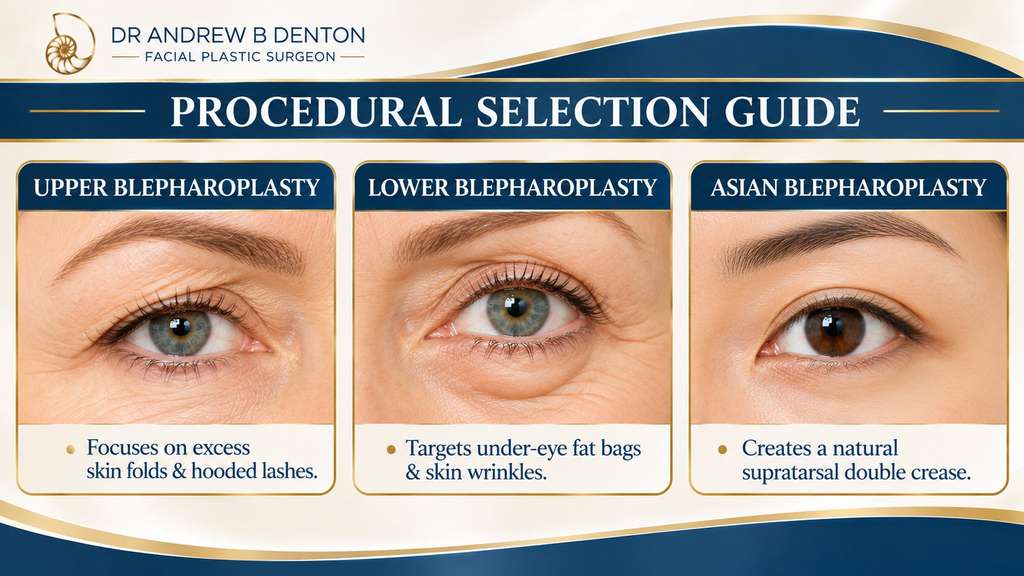
1. Upper Eyelid Blepharoplasty
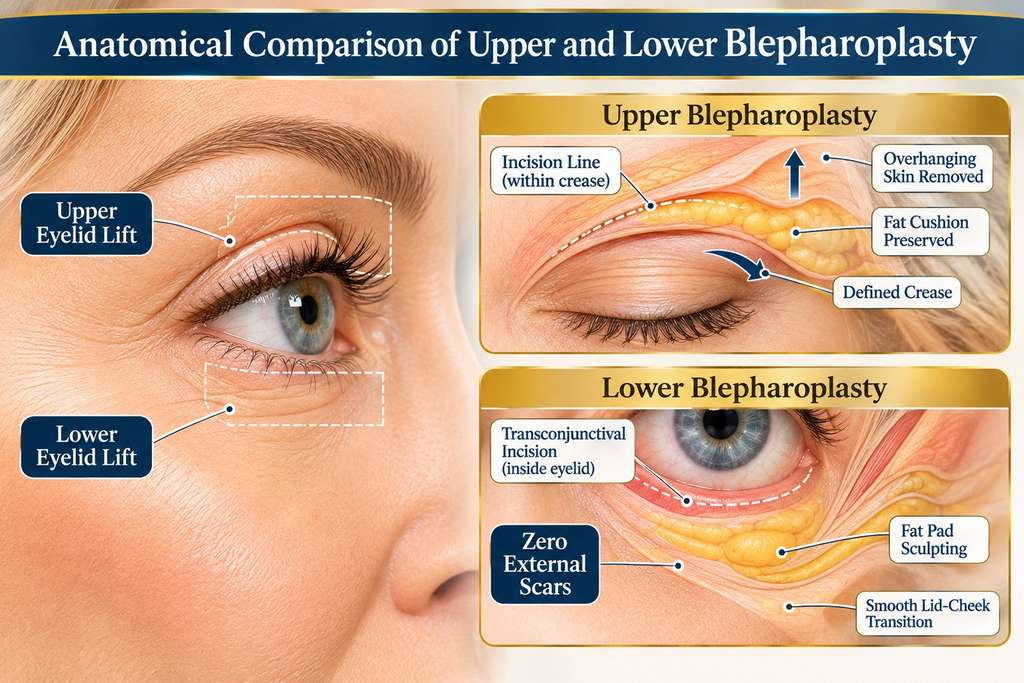
Upper blepharoplasty focuses on restoring clean contours between the eyelash line and the eyebrow. During this procedure, an incision is placed within the natural fold of the upper eyelid crease. Dr Denton trims surplus skin, adjusts underlying muscle tissue, and removes or repositions bulging fat pockets. Because the incision resides inside the crease fold, any resulting fine line heals discreetly and remains concealed when your eyes are open.
2. Lower Eyelid Blepharoplasty
Lower eyelid surgery addresses under-eye puffiness, baggy contours, and skin laxity. When the primary concern is displaced fat without significant skin excess, Dr Denton utilizes a transconjunctival technique. Incisions are placed on the internal lining of the lower lid, allowing fat cushions to be sculpted or repositioned with zero external skin incisions or visible scars. If loose or wrinkled skin is present, a fine external incision placed just beneath the lower lash line allows for precise skin trimming and muscle tightening.
3. Asian Blepharoplasty (Double Eyelid Surgery)
Asian blepharoplasty requires a specialized anatomical approach that differs from Caucasian eyelid surgery. Approximately half of individuals of East Asian descent possess a monolid, characterized by an absent or low-set upper lid crease, thicker subcutaneous fat, and an epicanthal fold over the inner corner of the eye.
The primary goal of double eyelid surgery is to construct an ethno-appropriate supratarsal crease that makes the eyes appear larger and more expressive while preserving cultural identity. Using an incisional or specialized suture method, the crease is secured so it rests naturally in balance with surrounding facial features.
Detailed Comparison of Eyelid Surgery Techniques
| Feature or Metric | Upper Blepharoplasty | Lower Blepharoplasty | Asian Blepharoplasty |
| Primary Target Area | Upper eyelid hooding and heavy skin folds | Under-eye bags, puffiness, and loose skin | Single fold (monolid) upper eyelid |
| Incision Location | Hidden inside upper eyelid crease | Inside lower lid (transconjunctival) or lash line | Incisional line along planned crease fold |
| Fat and Tissue Strategy | Trims excess skin and bulged medial fat | Sculpts, removes, or repositions orbital fat | Modifies fat and attaches skin to levator layer |
| Functional Advantage | Restores blocked peripheral vision | Smooths dark shadows and lid-cheek transition | Creates wider aperture and clears eyelashes |
| Scar Visibility | Concealed inside eyelid fold | Completely invisible externally (transconjunctival) | Hidden along the new crease line |
| Recovery Window | 5 to 7 days for stitch removal | 5 to 7 days for initial social activities | 5 to 10 days depending on technique |
The Core Benefits of Blepharoplasty: Aesthetic, Functional, and Psychological
Evaluating the benefits of blepharoplasty reveals why this procedure remains one of the most frequently requested facial cosmetic procedures worldwide. The transformative improvements extend across physical, visual, and personal dimensions.
Aesthetic Advantages: Restoring Open and Refreshed Eyes
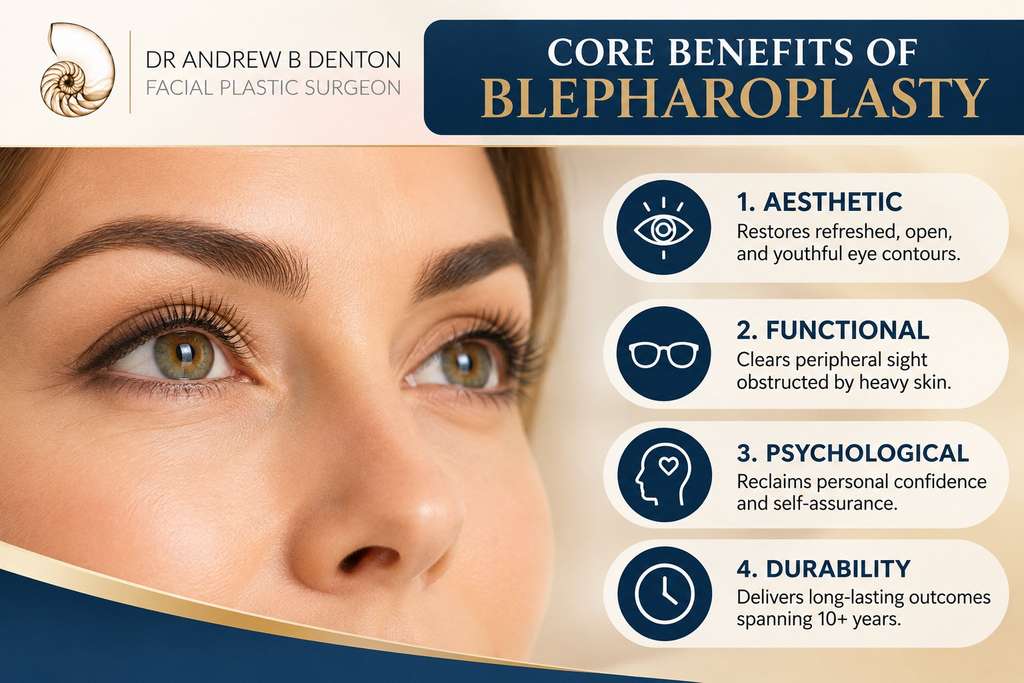
One of the chief benefits of blepharoplasty is the immediate restoration of bright, well-defined eye contours. Removing overhanging tissue uncovers the upper lid crease, making the eyes appear larger and more alert. On the lower lid, eliminating puffy fat bags creates a smooth, continuous transition between the lower eyelid and upper cheek, removing tired shadows.
Functional Advantages: Clearing Obstructed Vision
Beyond appearance, the visual benefits of blepharoplasty are life-changing for patients with severe upper lid sagging. Trimming heavy skin folds lifts physical weight off the eyelashes, immediately expanding your upper and lateral field of view. Patients frequently report reduced forehead strain and fewer tension headaches because they no longer need to lift their brows constantly to see clearly.
Psychological Advantages: Confidence and Emotional Alignment
Feeling self-conscious about looking tired or older than your actual age can affect your personal confidence. Examining the emotional benefits of blepharoplasty reveals a major boost in self-assurance that comes with seeing an invigorated reflection in the mirror. This positive shift often translates into greater comfort during social and professional gatherings.
Long-Lasting Structural Durability
When considering the long-term benefits of blepharoplasty, structural durability stands out. Because the surgery removes excess skin and permanently sculpts bulging fat pads, the structural improvements endure for ten to fifteen years or longer. For many mature patients, a single eyelid procedure provides lifetime satisfaction.
Functional vs. Aesthetic Advantages of Eyelid Lift Surgery
| Category | Specific Benefit Delivered | Clinical Explanation | Long-Term Patient Outcome |
| Functional | Peripheral Vision Restoration | Trims overhanging skin resting on eyelashes | Expands field of view for driving and reading |
| Functional | Reduced Forehead Fatigue | Eliminates need to lift brows for clear vision | Softens secondary forehead tension lines |
| Aesthetic | Crisp Eyelid Crease Definition | Uncovers obscured supratarsal upper fold | Improves eye shape and makeup application |
| Aesthetic | Under-Eye Contour Smoothing | Sculpts or repositions displaced fat cushions | Removes puffy bags and dark lower lid shadows |
| Psychological | Improved Emotional Alignment | Outward reflection matches inner energy levels | Boosts self-confidence in social settings |
| Longevity | Enduring Structural Stability | Removes excess tissue and re-anchors fat | Results endure for a decade or longer |
Dr Denton’s Vancouver Approach: Precision, Safety, and Patient Experience
Selecting a qualified facial plastic surgeon represents the single most important factor in achieving safe, natural results. Facial procedures require an intricate understanding of delicate ocular structures paired with refined surgical judgment.
All consultations, surgical procedures, and follow-up appointments take place at our private, state-of-the-art facility, West Coast Cosmetic Surgery Centre. Located in Vancouver’s medical corridor near Vancouver General Hospital, our clinic provides privacy, comfort, and convenience.
Procedural Sedation under Twilight Anaesthesia
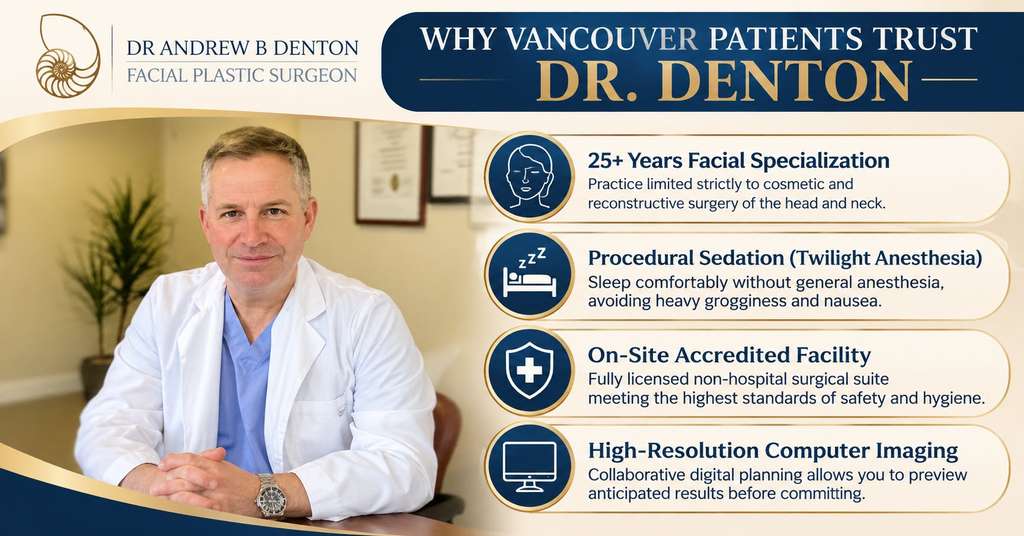
Eyelid surgeries at our accredited Vancouver facility are performed using twilight anaesthesia (procedural sedation). You sleep comfortably and free of pain throughout the operation without requiring general anaesthesia or a breathing tube.
Twilight anaesthesia prevents blood vessel dilation caused by general anaesthesia gases, lowering post-operative bruising and swelling. Patients awaken feeling alert and comfortable, allowing them to return home safely shortly after surgery.
Collaborative Planning with Computer Imaging
Dr Denton firmly believes that informed patients make the best decisions. You should always feel like an equal member of your decision-making team. During your private consultation, we utilize high-resolution digital computer imaging. By reviewing proposed changes directly on your photograph, we evaluate how surgical adjustments will look, ensuring our goals align completely before treatment begins.
Key Takeaway: The Three Pillars of Natural Eyelid Rejuvenation
- Precise Tissue Removal: Remove only necessary skin and fat to prevent a hollow, sunken eye appearance.
- Hidden Incisions: Place incisions strictly inside natural folds or on the interior lid surface for zero visible marks.
- Ethno-Appropriate Balance: Respect individual ethnic characteristics and facial proportions to preserve authentic identity.
Synergistic Procedures: Achieving Complete Upper Facial Harmony
While eyelid surgery effectively addresses drooping upper skin and under-eye fat bags, it does not stop the sagging of eyebrows or smooth dynamic forehead wrinkles. To achieve complete facial balance, blepharoplasty is frequently combined with complementary procedures.
Forehead Lift / Brow Lift
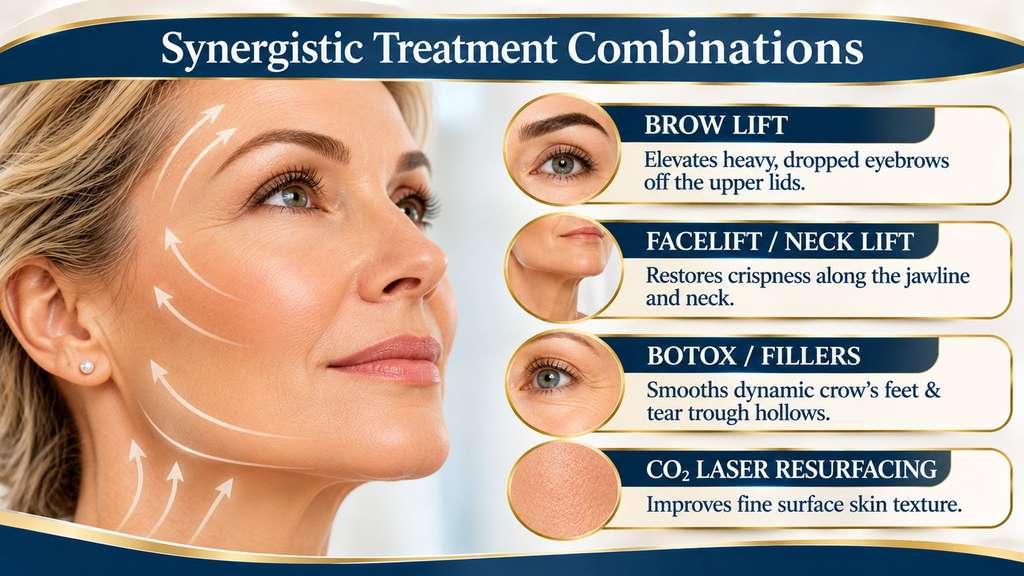
If your eyebrows have dropped significantly with age, they can push forehead skin down onto your upper eyelids, worsening eyelid hooding. Performing a brow lift alongside upper blepharoplasty elevates sagging eyebrows back to their natural position, opening the upper third of your face.
Facelift or Neck Lift
For patients experiencing jowling or loose neck skin alongside eyelid ageing, combining a facelift or neck lift with blepharoplasty ensures that all facial features age at the exact same rate, consolidating your surgical recovery into a single window.
Injectables
Dynamic wrinkles around the outer corners of the eyes, commonly called crow’s feet, are caused by muscle movement rather than loose skin. Botox Cosmetic injections can be added to smooth fine surface lines, while tear trough fillers soften hollows along the upper cheek.
Recovery and Aftercare: What to Expect After Surgery
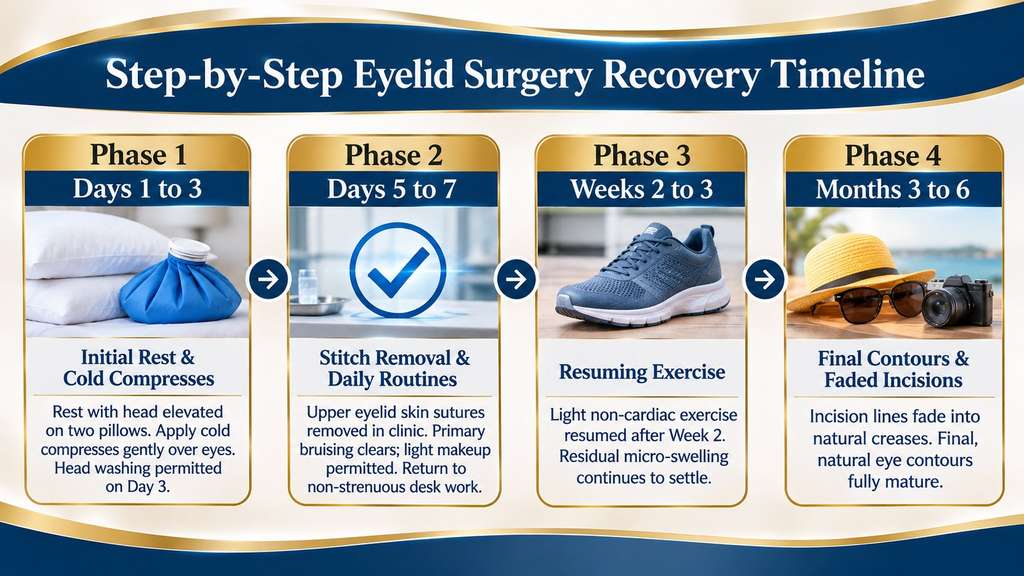
Eyelid tissue possesses a rich blood supply, which allows incisions around the eyes to heal rapidly compared to other surgical sites. Understanding the post-operative journey helps ensure a smooth, comfortable recovery.
Days 1 to 3: Initial Care and Protection
During the first 24 hours, rest quietly with your head elevated on two pillows. Applying cold compresses gently over your eyes during the first 48 hours helps minimize initial swelling and soothing discomfort. You are permitted to shower and gently wash your hair three days after surgery.
Days 5 to 7: Stitch Removal and Daily Activities
External skin sutures on the upper eyelids are removed in our clinic five to seven days after surgery. Sutures placed on the interior of the lower lid dissolve automatically. Light makeup can be applied to the upper lids as soon as incisions heal, and most patients comfortably return to work and light social activities seven days post-surgery.
Weeks 2 to 3: Physical Exercise
Strenuous activities, heavy lifting, and bending should be avoided for two weeks to prevent pressure on healing delicate tissue. Light, non-cardiac exercise can be resumed after fourteen days and gradually increased over the following week.
Frequently Asked Questions
How long do the aesthetic and functional benefits of blepharoplasty last?
The primary benefits of blepharoplasty endure for ten to fifteen years or longer. While normal facial ageing continues naturally, your eyes will consistently appear brighter and more refreshed than without surgical intervention.
Will lower eyelid blepharoplasty leave visible scars on my face?
When lower blepharoplasty utilizes the transconjunctival approach, all incisions are placed inside the eyelid lining, leaving zero external scars. External skin incisions are hidden discreetly just beneath the lower lash line.
Can an upper eyelid lift improve my field of vision?
Yes, upper eyelid surgery improves vision. When heavy upper eyelid skin hangs low enough to rest on your eyelashes, it creates a physical obstruction that blocks peripheral sight. Trimming excess tissue clears your vision.
Is eyelid lift surgery painful during or after the procedure?
Eyelid lift surgery involves minimal post-operative discomfort. Performed under twilight anaesthesia, you sleep comfortably during surgery. Any mild post-operative tightness is easily managed with mild medication for a few days.
How much time should I plan to take off work?
Most patients take seven days off work following upper or lower eyelid surgery. By day seven, skin sutures are removed, initial swelling clears, and light makeup easily conceals lingering discolouration.
Can eyelid surgery be combined with a brow lift or facelift?
Yes, eyelid surgery combines effectively with other procedures. Pairing blepharoplasty with a brow lift or facelift ensures uniform facial rejuvenation while consolidating your recovery into a single timeframe and reducing overall fees.
Refresh Your Eyes: Schedule Your Consultation with Dr Denton
If heavy upper lids, under-eye bags, or hooded skin are affecting your appearance or vision, and you are ready to experience the benefits of blepharoplasty, we invite you to take the next step. Align your outward reflection with your inner health and vitality by booking a private consultation with Dr Andrew Denton.
Together, we will evaluate your eye anatomy, review digital computer imaging, and construct a tailored surgical plan designed to achieve a well-proportioned, rested, and authentic result.
Contact Dr Andrew B. Denton Today:
- Phone: (604) 879-3223
- Address: 943 W Broadway #202, Vancouver, BC V5Z 4E7, Canada
- Online Consultation Request: doctordenton.com/consultation
- Office Hours: Monday to Friday, 9:00 am to 4:30 pm
Located conveniently in the heart of Vancouver’s medical corridor, just one block from Vancouver General Hospital.
Medical disclaimer: This article provides general information only. It is not medical advice, diagnosis, or treatment. Facelift surgery carries risks, and individual results vary and cannot be promised. Consult a qualified facial plastic surgeon about your own situation.