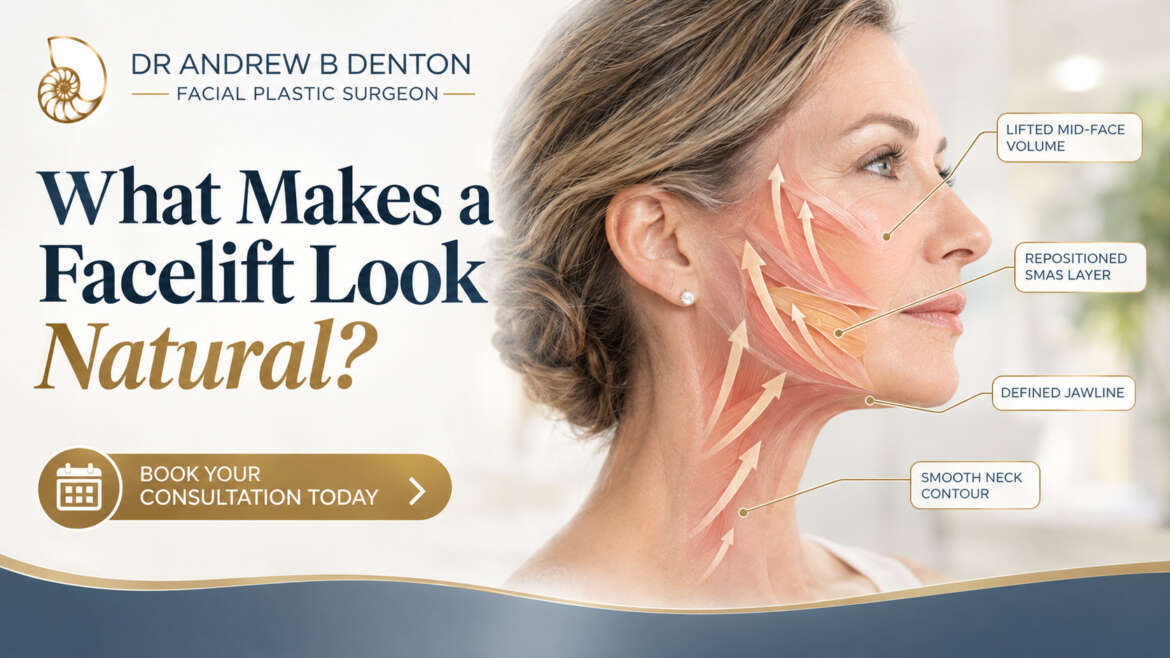
When you consider facial plastic surgery to revitalize your appearance, one specific concern usually sits at the top of your mind: looking unnatural. Most people have seen individuals who look perpetually startled, windswept, or pulled back following surgery. These artificial outcomes lead many prospective patients in Vancouver, Burnaby, and Richmond to hesitate, wondering if a surgical refresh can preserve their authentic facial character.
Cosmetic facial surgery has advanced considerably over recent decades. Achieving a natural facelift is no longer an uncommon stroke of luck. Instead, predictable and authentic outcomes stem directly from an accurate understanding of facial anatomy, meticulous surgical technique, and individualized planning.
Modern surgical techniques move well beyond stretching the skin. They focus on elevating the deeper structural foundation of the face to its original, youthful position. As a board-certified facial plastic surgeon in Vancouver with 25 years of experience dedicated strictly to the head and neck, Dr Denton designs every procedure around a clear standard which is that your surgery should never look like surgery. The primary objective of a natural facelift is to leave you looking healthy, well-rested, and well-proportioned.
The Evolution of Facial Surgery: Moving Beyond Skin-Only Tightening
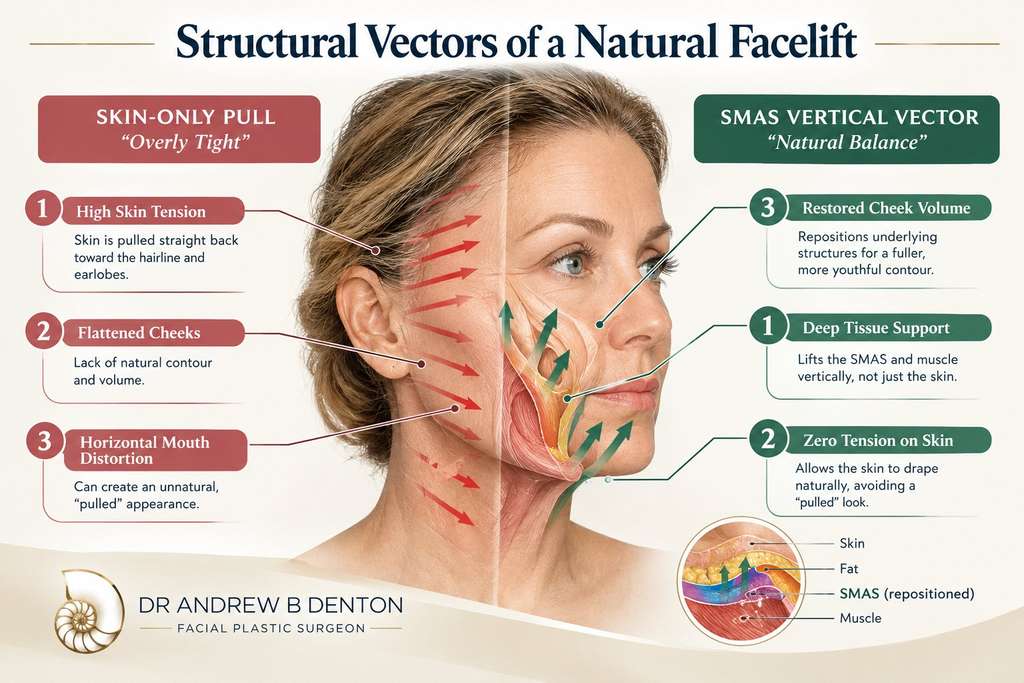
To understand why a modern facelift looks so natural, it helps to examine how facial surgery developed historically. In the early days of rhytidectomy, surgeons focused almost entirely on the surface skin layer. They pulled the skin horizontally toward the ears, trimmed the excess, and closed the incisions under considerable tension.
That older approach suffered from two major technical flaws:
- Horizontal Distortion: Pulling skin sideways created a flattened, wide appearance across the mouth and cheeks, producing the notorious wind-tunnel effect.
- Short-Lived Results: Human skin possesses elastic properties. When surgeons rely on skin tension alone to support sagging tissue, the skin quickly stretches out again.
- Wrinkles and jowls reappear within a few years, while surgical scars widen under the constant pull.
The turning point in facial rejuvenation occurred when surgeons recognized that facial ageing occurs across multiple anatomical layers. Over time, gravity, collagen loss, and muscle laxity cause internal fat pads and muscle structures to shift downward. The skin does not stretch independently; it simply follows the descent of the underlying tissue.
Consequently, an authentic natural facelift addresses the deeper muscular foundation rather than pulling on delicate surface skin.
The Anatomical Key: Why Deep Tissue Lifting (SMAS) Matters
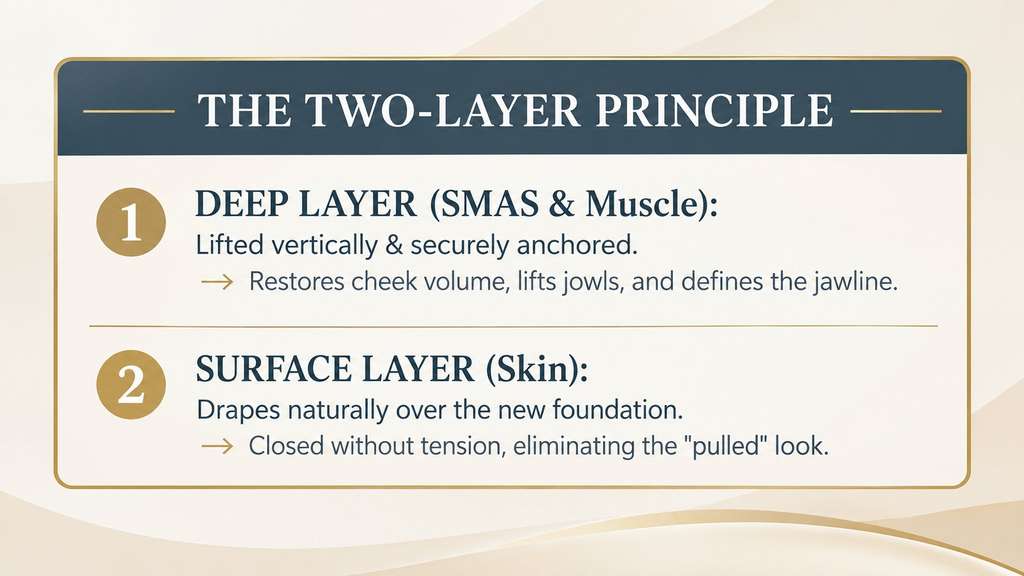
The anatomical foundation of a natural facelift rests upon a fibrous muscle layer known as the Superficial Musculoaponeurotic System, or SMAS. The SMAS layer connects your facial expression muscles to the subcutaneous fat and overlying skin. When jowls form along your jawline or deep folds develop between your nose and mouth, the underlying SMAS layer has drifted downward.
During a modern SMAS facelift or deep-plane facelift, Dr Denton places discreet incisions within the natural contours around the front and back of the ear. Through these hidden access points, he adjusts and elevates the deeper SMAS layer. Rather than pulling the skin, he repositions the descended muscle tissue and structural fat pads vertically, placing them back over the cheekbones where they rested years earlier.
Once the internal frame is securely anchored, the outer skin drapes loosely over its restored support system. Surplus skin is trimmed away gently, and incisions are closed without tension.
What Can Make a Facelift Look Unnatural?
Several factors may contribute to an unnatural result. None guarantees one, and they often overlap. Each is worth discussing before surgery:
- Excessive skin tension may contribute to a pulled or windswept look.
- A technique poorly matched to the patient’s anatomy can leave the main concern unaddressed.
- Overcorrection can be associated with an operated appearance.
- Inadequate attention to the neck or jawline can leave a visible mismatch between the lower face and neck.
- Failure to account for volume loss may leave hollowness even after tissue is lifted.
- Unrealistic expectations can make a technically sound result feel disappointing.
- Ignoring skin quality and fine lines matters, because a facelift does not resurface skin.
- Inadequate postoperative care, such as skipping instructions or visits, can affect healing and scars.
- Choosing a surgeon without appropriate training or facelift experience is worth examining closely before you commit.
Mistakes to Avoid
- Choosing a procedure based only on price.
- Assuming a shorter operation is always better.
- Treating social media images as promised outcomes.
- Failing to ask about credentials and facility accreditation.
- Not disclosing medications, smoking, medical conditions, or prior procedures.
- Expecting surgery to stop future ageing.
- Scheduling surgery without planning adequate recovery time.
Traditional Skin-Only Facelift vs. Modern SMAS / Deep-Plane Facelift
| Feature or Metric | Traditional Skin-Only Facelift | Modern SMAS / Deep-Plane Facelift |
| Primary Structural Target | Outer skin layer only | Deep muscle and fibrous tissue (SMAS layer) |
| Lifting Vector | Horizontal (pulled sideways toward ears) | Vertical (restored upward to original position) |
| Visual Result | Stretched, flat, or wind-blown | Rested, soft, well-contoured, and natural |
| Longevity | Short-lived (1 to 3 years) | Long-lasting (7 to 10+ years) |
| Incision Healing | High tension can cause widened scars | Zero tension on skin allows minimal, discreet scars |
| Jowl & Neck Correction | Temporary surface smoothing | Complete structural repositioning along jawline |
By separating deep structural lifting from the skin closure, patients gain three significant advantages:
- Natural Expressions: Your expressions remain soft and flexible because the skin is not under tight tension.
- Discreet Incisions: Incisions closed without tension heal as fine, thin lines that blend into the ear folds.
- Durable Improvement: Adjustments made to deeper fibrous layers last seven to ten years or longer, allowing your face to age naturally over time.
Customized Surgical Techniques: Matching Surgery to Your Unique Structure
No two faces age in the exact same manner. A common mistake in cosmetic surgery involves applying a rigid, identical approach to every individual. Delivering a natural facelift requires tailoring the surgical technique to your specific anatomy, tissue elasticity, age, and personal goals.
During your consultation at our Vancouver clinic, we evaluate several surgical variations to determine the most harmonious path forward:
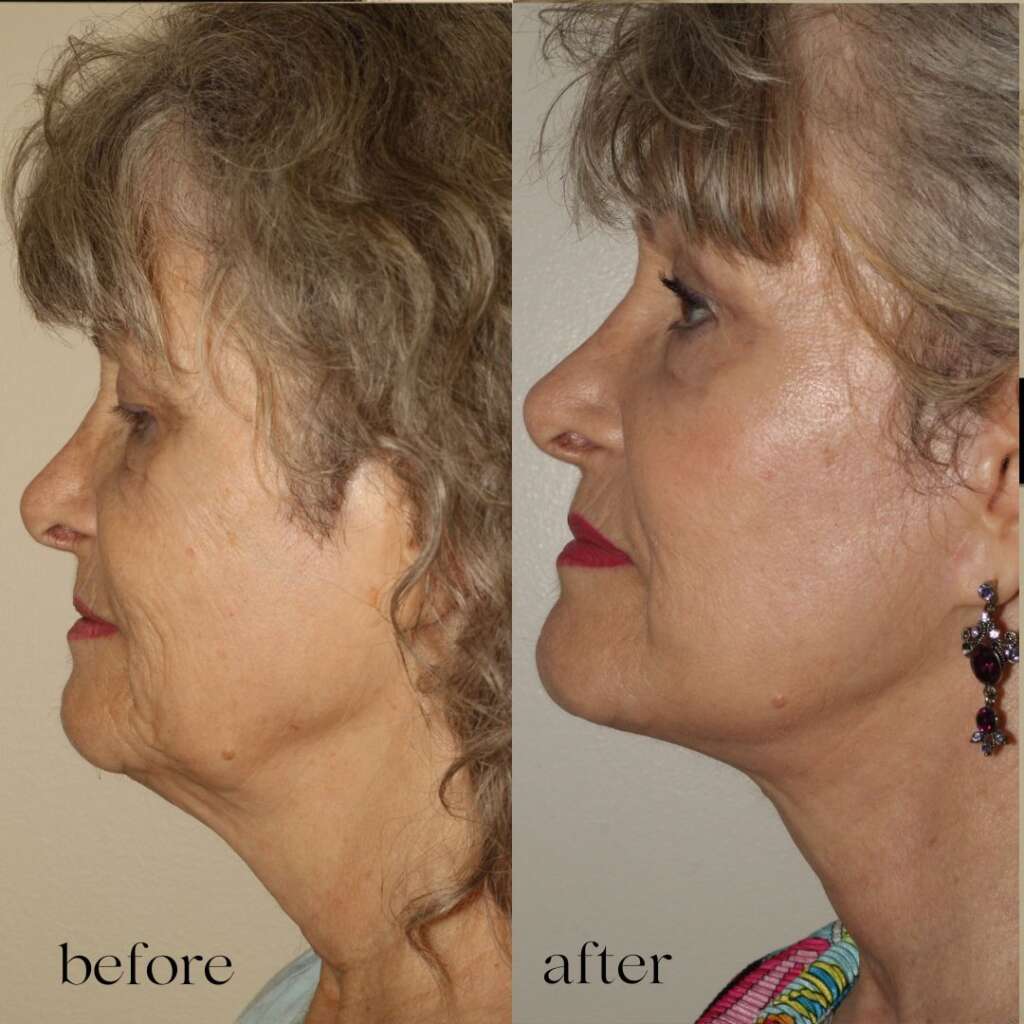
1. The Full Facelift
A full facelift provides comprehensive rejuvenation for individuals experiencing moderate to advanced laxity across the mid-face, lower face, and neck. It corrects deep nasolabial folds, pronounced jowls, and loose neck skin by re-anchoring the internal structures and removing excess skin.
2. The Mini Facelift
The mini facelift is an ideal option for patients in their late 30s and 40s who are beginning to notice early signs of ageing, particularly mild skin laxity in the lower half of the face and early jowling. This procedure focuses strictly on addressing these subtle, early-stage changes rather than comprehensive facial ageing. Unlike more extensive surgical techniques, a standard mini facelift is minimally invasive, featuring shorter incisions around the ears and a quicker recovery time.
It is designed primarily to tighten and redistribute the skin, so it typically does not involve manipulating the deeper SMAS layer or performing extensive deep-plane tissue work. While this allows for a faster return to daily activities, it means the procedure is best suited for targeted, surface-level structural refinement.
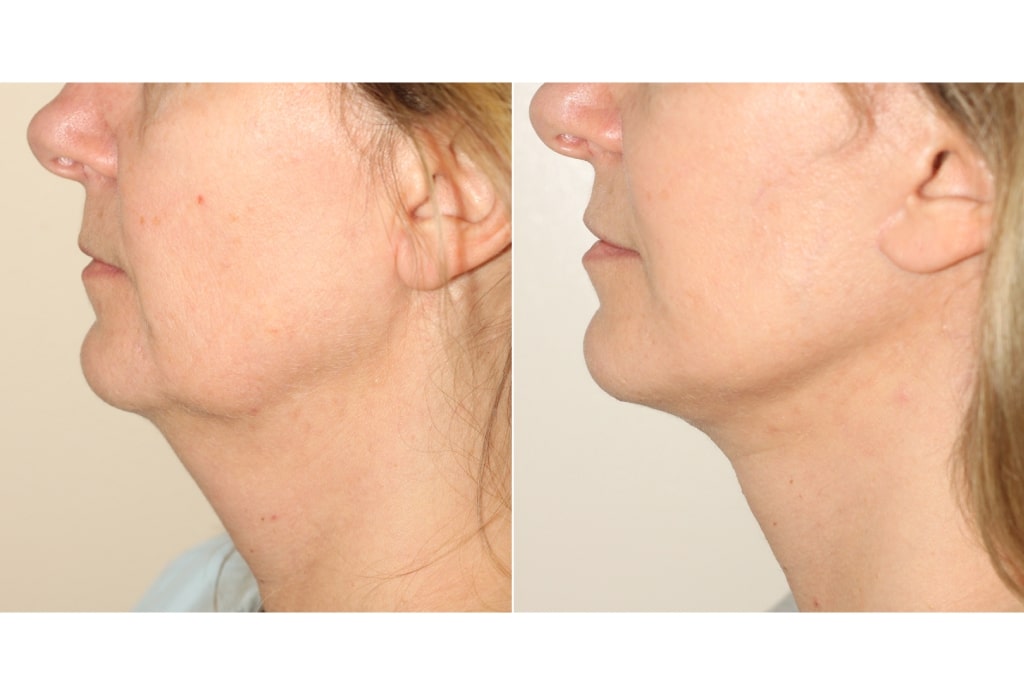
3. The Partial or Lower Facelift
A partial or lower facelift concentrates on the lower third of the face, correcting jowls and marionette lines around the mouth. It basically addresses either the neck or the jawline but not both. It serves individuals who feel their eyes and forehead remain youthful but wish to restore crisp definition to their jawline or upper neck.
4. Synergistic Multi-Procedure Combinations
Facial ageing rarely affects just one area. If your jawline is tightened but your neck shows muscle banding or your eyelids appear heavy, your overall profile can look mismatched.
To preserve overall facial balance, we frequently combine a natural facelift with complementary procedures:
- Neck Lift (Platysmaplasty): Tightens separated neck muscles along the midline to smooth out vertical bands and firm the neck profile.
- Eyelid Surgery (Blepharoplasty): Removes drooping upper eyelid skin or under-eye fat deposits using delicate incisions or laser techniques.
- Facial Liposuction or Submentoplasty: Removes localized fat deposits beneath the chin to sharpen the neck-jawline angle.
- Facial Implants: Integrates a biocompatible silicone chin or cheek implant to enhance weak bone structure and support overlying tissue.
Facelift Procedure Variations & Synergistic Combinations
| Procedure Option | Primary Focus Area | Key Aesthetic Benefits | Typical Recovery Window |
| Mini Facelift | Lower half of the face (mild skin laxity & early jowling) | Surface-level skin tightening and redistribution without deeper SMAS manipulation; shorter incisions | 5 to 7 days (quicker return to daily routines) |
| Lower / Partial Facelift | Lower third of the face (jowls, marionette lines; addresses either neck OR jawline, but not both) | Focused refinement to restore crisp definition to the jawline or upper neck without altering the upper face | 7 to 10 days |
| Full SMAS Facelift | Mid-face, lower face, jowls, and upper neck | Comprehensive structural restoration across the face | 10 to 21 days |
| Facelift + Neck Lift | Lower face, jawline, submental area, and neck | Smooths neck bands and eliminates double chin laxity | 10 to 21 days |
| Facelift + Blepharoplasty | Lower face, jawline, upper eyelids, and under-eye bags | Refreshes heavy or tired eyes alongside jawline lifting | 10 to 14 days |
Key Takeaway: The Three Pillars of a Natural Facelift
- Lift Tissue Vertically: Elevate deeper muscle layers (SMAS) upward to counteract gravity rather than pulling skin backward.
- Avoid Skin Tension: Close skin incisions loosely without pulling, allowing scars to heal discreetly and expressions to stay soft.
- Harmonize Surrounding Features: Combine lower face lifting with neck contouring or eyelid surgery so all features age at the exact same rate.
Candidate Selection & Pre-Surgical Preparation
A successful surgical outcome begins long before entering the operating suite. Identifying whether you are a suitable candidate for a natural facelift ensures that your expectations align with what surgery can realistically accomplish.
CANDIDATE CHECKLIST FOR A NATURAL FACELIFT
You notice sagging in the lower face, jowls, or neck.
You possess good skin elasticity and underlying bone structure.
You are in good general health without unmanaged conditions.
You do not smoke, or will stop completely 2 weeks prior.
You desire a refreshed look rather than an altered identity.
You understand that surgical results age naturally over time.
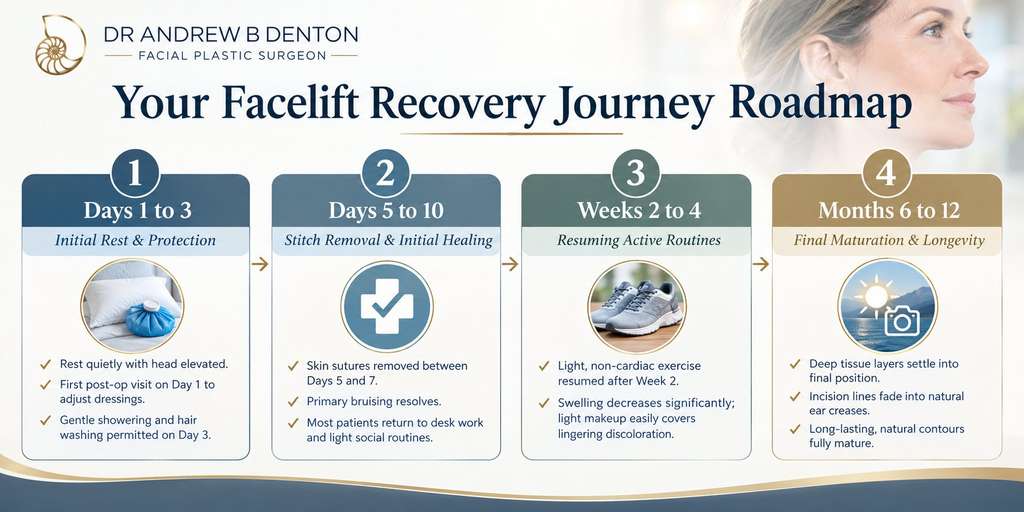
Adhering strictly to pre-surgical preparation guidelines supports a smooth recovery and minimizes post-operative swelling:
- Discontinue Blood Thinners: Stop taking aspirin, ibuprofen, vitamin E, ginkgo biloba, and ginseng two weeks prior to surgery to reduce bleeding and bruising.
- Observe Pre-Op Fasting: Consume no food or liquids (including water or tea) after midnight on the night before your procedure. An empty stomach prevents post-operative nausea.
- Organize Transportation and Support: Arrange for a responsible adult to drive you home following surgery and stay with you for the initial 24 hours.
Dr Denton’s Vancouver Practice: Expertise, Safety, and Collaboration
Choosing your facial surgeon represents the most critical decision in your aesthetic journey. Facial plastic surgery demands a thorough knowledge of head and neck anatomy, paired with an artistic understanding of facial proportion.
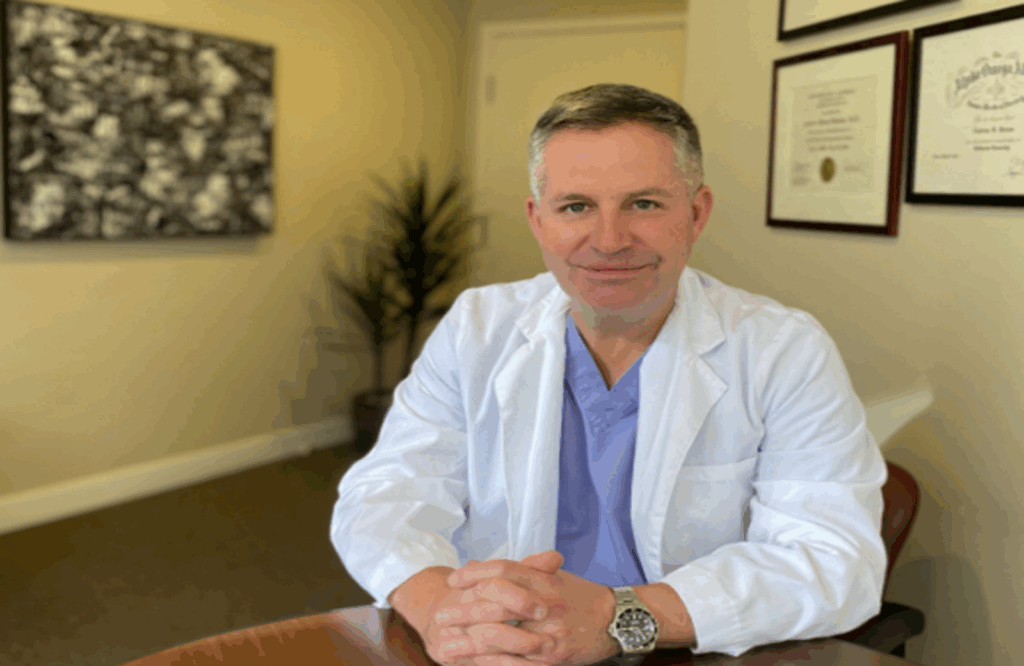
As an Assistant Clinical Professor in the Department of Surgery at the University of British Columbia, Dr Denton remains active in teaching surgical residents and advancing clinical standards. All consultations, procedures, and post-operative follow-up appointments take place at our private facility, West Coast Cosmetic Surgery Centre. Located in Vancouver’s medical corridor near Vancouver General Hospital, our clinic offers simplicity, comfort, and privacy throughout your care.
WHY VANCOUVER PATIENTS TRUST DR DENTON
- 25 Years of Facial Specialization: Practice limited exclusively to cosmetic and reconstructive surgery of the head and neck.
- Dual Board Certification: Certified by the Royal College of Physicians and Surgeons of Canada and the American Board of Facial Plastic and Reconstructive Surgery.
- Procedural Sedation (Twilight Anaesthesia): Performed without general anaesthesia, reducing blood vessel dilation, bruising, and risks.
- On-Site Accredited Facility: Fully licensed non-hospital surgical facility meeting rigorous standards of safety and hygiene.
- High-Resolution Computer Imaging: Collaborative digital planning allows you to preview expected results before committing.
The Clear Advantage of Twilight Anaesthesia
At our accredited Vancouver surgical suite, facelift procedures are performed under procedural sedation, often called twilight anaesthesia. You sleep comfortably throughout the entire surgery without requiring a breathing tube or deep general anaesthesia.
This specialized sedation technique offers distinct clinical benefits:
- Decreased Bleeding and Bruising: Avoiding general anaesthesia gases prevents excessive blood vessel dilation during surgery.
- Minimized Post-Op Nausea: Patients awaken feeling alert and comfortable, without the grogginess or nausea associated with general anaesthesia.
- Efficient Recovery: Patients recover smoothly in our post-operative area before returning home the same day.
Collaborative Decision-Making with Computer Imaging
Dr Denton believes firmly that informed patients make the best decisions. You should always feel like an equal member of the decision-making team. During your private, unhurried consultation, we utilize high-resolution digital computer imaging.
By reviewing proposed modifications directly on your digital photograph, we evaluate how various adjustments impact your overall facial balance. This collaborative process ensures that your goals and his surgical plan align completely before any treatment begins.
Frequently Asked Questions
How long do the results of a natural facelift last?
A natural facelift performed by elevating the deeper SMAS muscle layer typically provides lasting rejuvenation for seven to ten years. While normal ageing continues, you will consistently look younger than without surgery.
Will I have visible scars after facelift surgery?
Incisions are placed discreetly within natural ear creases and hairline borders. As incisions mature over several months, resulting scars fade significantly, becoming virtually unnoticeable during routine social interactions.
Can a facelift be combined with other facial procedures?
Yes. Combining a facelift with a neck lift, eyelid surgery, or chin implant ensures uniform rejuvenation across your entire face. Performing procedures together consolidates recovery time and reduces overall facility and anaesthesia expenses.
How does computer imaging help during the consultation?
Digital computer imaging allows you to preview potential surgical outcomes on your photograph during your consultation. This collaborative tool ensures you and Dr. Denton share identical aesthetic expectations before scheduling your procedure.
Am I too young or too old for a facelift?
There is no single age cutoff. Candidacy depends on facial structure, skin quality, degree of laxity, health, and goals rather than age alone. An examination with a qualified surgeon is the only way to judge suitability.
Can a facelift correct neck laxity and jowls?
A facelift can address jowls and some neck laxity by repositioning and tightening tissue, and a neck lift may be added when neck bands or loose skin are prominent. Your surgeon decides after examining your face and neck.
Is a facelift better than fillers?
Neither is better for everyone. Fillers restore volume without surgery, while a facelift repositions sagging tissue. However, the American Society of Plastic Surgeons (ASPS) states that minimally invasive treatments cannot achieve the same results as surgery, so your anatomy and goals should guide the choice.
How do I choose a facelift surgeon in Vancouver?
Check certifications, facelift experience, facility accreditation, risk discussion, follow-up arrangements, and communication style. Ask why a technique is recommended for you, and be cautious about promised results or comparisons based only on price.
Reclaim Your Refreshed Appearance: Book Your Consultation
If you are ready to explore how a natural facelift can revitalize your appearance while preserving your authentic character, we invite you to take the next step. Align your outward reflection with your inner health and vitality by scheduling a private consultation with Dr Andrew Denton.
Together, we will evaluate your facial features, review digital computer imaging, and construct a tailored surgical plan designed to achieve a well-proportioned, rested, and natural result.
Contact Dr Andrew B. Denton Today:
- Phone: (604) 879-3223
- Address: Suite 202 – 943 West Broadway, Vancouver, BC V5Z 4E1
- Online Consultation: doctordenton.com/consultation
- Office Hours: Monday to Friday, 9:00 am to 4:30 pm
Located conveniently in the heart of Vancouver’s medical corridor, just one block from Vancouver General Hospital.
Medical disclaimer: This article provides general information only. It is not medical advice, diagnosis, or treatment. Facelift surgery carries risks, and individual results vary and cannot be promised. Consult a qualified facial plastic surgeon about your own situation.