
Patients who come to our Vancouver practice asking about nose surgery often arrive with the same underlying question, even if they phrase it differently: will fixing my nose actually make my face look balanced? That question is exactly why the choice between rhinoplasty and profileplasty matters so much. Rhinoplasty reshapes the nose in isolation. Profileplasty looks at the whole facial profile, the nose, chin, and sometimes the jawline, as one connected system. Choosing correctly between rhinoplasty and profileplasty can be the difference between a result that looks surgically altered and one that looks naturally proportioned.
As a facial plastic surgeon practicing in Vancouver, Dr Denton has spent a significant part of every consultation walking patients through this distinction. Many people request a “nose job” when what their face actually needs is a coordinated plan involving the chin or jaw. Others assume they need multiple procedures when a well-executed rhinoplasty alone will resolve their concern. In this article, Dr Denton explains how rhinoplasty and profileplasty differ, how to tell which approach fits your face, and what to expect at each stage of the process.
What Is Rhinoplasty?
Rhinoplasty, colloquially known as a nose job, is a specialized surgical procedure designed to alter the structural framework of the nose. This framework consists of bone in the upper third, pliable cartilage in the lower two-thirds, and an overlying layer of soft tissue and skin. Through precise surgical manipulation, rhinoplasty can refine a prominent dorsal hump, narrow wide nostrils, reshape a bulbous tip, or straighten a deviated nasal septum. Beyond aesthetic adjustments, it frequently restores proper airflow for patients suffering from structural breathing blockages.
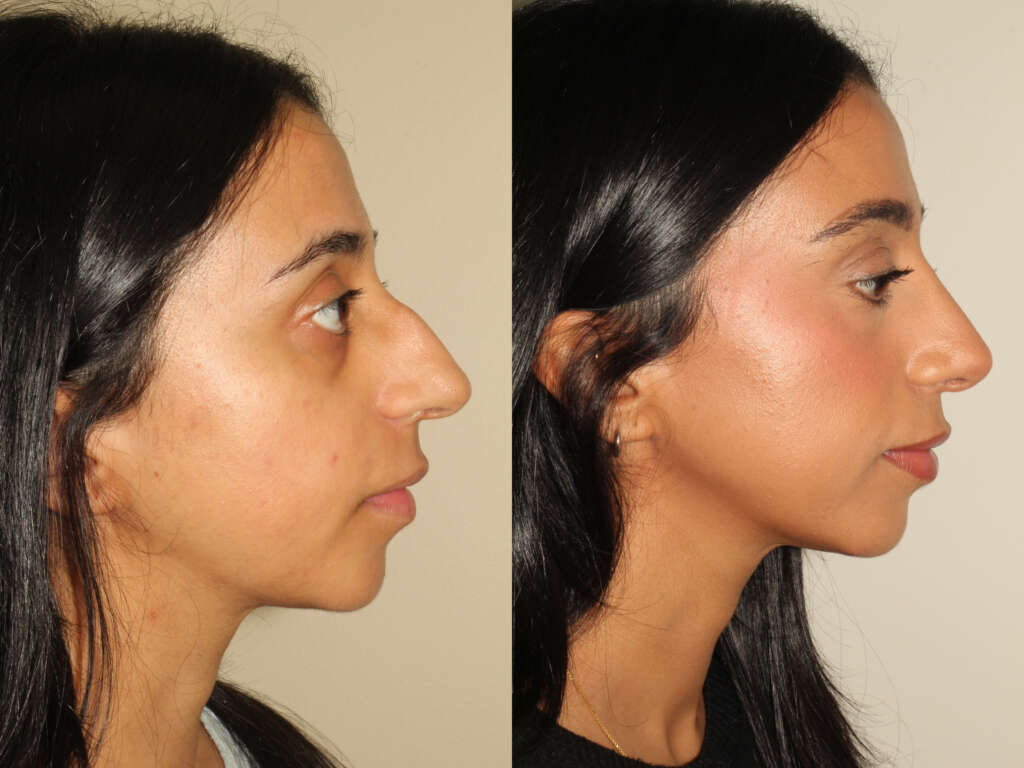
From a technical perspective, nasal surgery is widely recognized as one of the most intricate procedures in facial plastic surgery. Because the nose sits at the exact geometric center of the face, even sub-millimeter modifications alter the visual weight of surrounding features. Furthermore, a surgeon must preserve or improve internal airway mechanics while reshaping delicate skeletal structures. Achieving a natural outcome that functions flawlessly demands an intimate understanding of complex nasal anatomy and tissue behaviour.
Rhinoplasty is performed through either a closed approach, where incisions are hidden inside the nostrils, or an open approach, where a small incision is placed across the columella, the strip of tissue between the nostrils. The choice depends on the complexity of the case. In Dr Denton’s practice, more intricate tip work or revision cases usually call for an open approach because it gives better visibility of the cartilage framework.
With over 25 years of surgical practice focused exclusively on the head and neck, Dr Denton’s approach emphasizes subtle refinement rather than drastic alterations. The objective is never to produce an operated look, but rather to create a nose that blends harmoniously with your facial structure while supporting clear breathing.
Key Takeaway: Rhinoplasty modifies the central anchor of the face to refine nasal shape, symmetry, and breathing function. However, its aesthetic success depends heavily on how well the new nasal contours harmonize with your chin, jawline, and forehead.
What Is Profileplasty?
Profileplasty is a broader surgical concept rather than a single operation. It refers to reshaping the entire facial profile, most often by combining rhinoplasty with chin augmentation, and sometimes with jaw contouring or a lip lift. The goal is not just a better-looking nose or a stronger chin individually, but a profile where the forehead, nose, lips, and chin form a smooth, proportionate line when viewed from the side.
The logic behind profileplasty comes from basic facial proportion. If the chin sits noticeably behind the vertical line of the lower lip, a nose that is otherwise well shaped can appear larger than it actually is, simply because there is nothing at the other end of the profile to balance it. Reducing the nose alone in that situation can help, but adding a small chin implant or sliding genioplasty often produces a far more natural-looking outcome with less alteration to the nose itself.
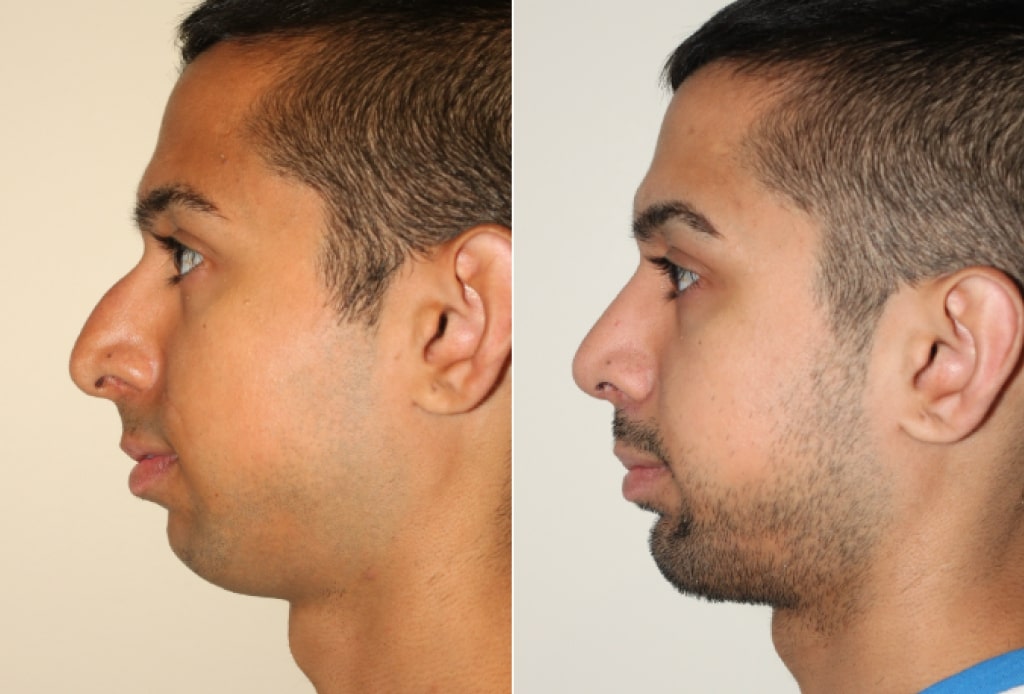
This is the central reason surgeons and patients weigh rhinoplasty and profileplasty together rather than treating them as competing options. In many cases, they are not alternatives at all. They are complementary steps toward the same goal of facial harmony.
Common profileplasty configurations pair open rhinoplasty with:
- Chin Augmentation (Mentoplasty): Inserting a custom-contoured solid silicone implant over the lower jawbone to increase projection and define the jawline.
- Submentoplasty or Neck Liposuction: Removing localized fat deposits (liposuction) under the chin using micro-cannulas, restoring a crisp angle between the neck and jawline.
- Facelift or SMAS Neck Lift: Tightening deeper muscular layers to address lower facial sagging alongside nasal refinement.
By addressing these connected features simultaneously, profileplasty establishes structural symmetry across the entire profile.
Rhinoplasty vs. Profileplasty: A Side-by-Side Comparison
The table below summarizes how rhinoplasty and profileplasty differ in scope, goals, and recovery, which is one of the most common questions patients bring to a first consultation.
| Feature / Consideration | Standalone Rhinoplasty | Combined Profileplasty |
| Primary Scope | Focuses exclusively on nasal bone, cartilage, and soft tissue. | Addresses the nose along with the chin, jawline, or neck. |
| Aesthetic Goal | Refines nasal humps, tip shape, nostril width, or symmetry. | Establishes total profile projection and proportional balance. |
| Anatomical Impact | Alters central facial features. | Balances central and lower facial anchor points. |
| Surgical Incisions | Small columellar incision (open) or internal nostril incisions. | Columellar incision plus small intraoral or submental incisions. |
| Number of Areas Treated | One | Two or more |
| Typical Surgery Time | 1.5 to 3 hours | 2.5 to 4 hours, depending on combined procedures |
| Incision Locations | Inside or across the nostrils | Nostril incisions plus a small incision under the chin or inside the mouth |
| Anesthesia Type | Procedural sedation (twilight anesthesia). | Procedural sedation (twilight anesthesia). |
| Recovery Window | 7 to 14 days for initial work return. | 7 to 14 days for initial work return (concurrent recovery). |
| Final Results Visible | 6 to 12 months | 6 to 12 months, with chin swelling often settling sooner than nasal swelling |
| Goal of the Result | A nose that fits the existing face | A profile where every feature supports the others |
| Financial Efficiency | Standard single-procedure pricing. | Reduced overall cost by bundling facility and anesthesia fees. |
The Science of Facial Harmony
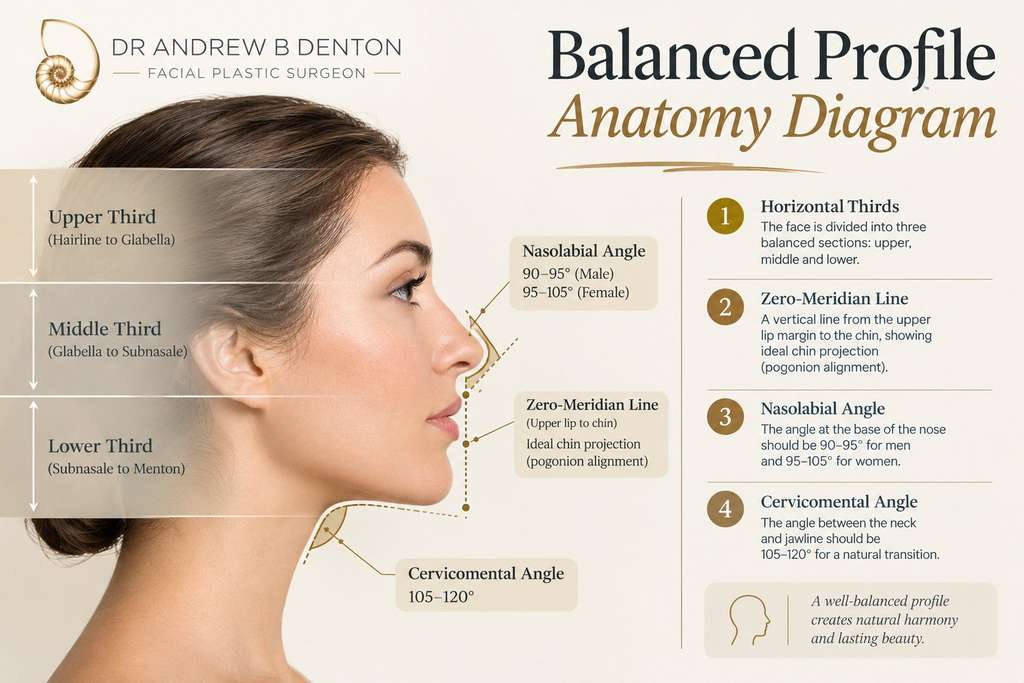
Aesthetic evaluation relies on time-tested anatomical proportions rather than subjective trends. In facial plastic surgery, we divide the face into equal horizontal thirds:
- the upper third from the hairline to the brows,
- the middle third from the brows to the base of the nose, and
- the lower third from the nose base to the bottom of the chin.
Vertical symmetry is evaluated alongside profile projections to ensure balance across all angles.
When analyzing a side profile, several specific anatomical relationships dictate facial harmony:
- The Nasolabial Angle: The angle formed where the upper lip meets the base of the nose. Ideally, this angle ranges between 90 to 95 degrees in men and 95 to 105 degrees in women.
- The Cervicomental Angle: The transition point between the chin and the neck, which should form a clean, slightly concave angle between 105 and 120 degrees.
- Chin Projection (The Zero-Meridian Line): In a balanced profile, a vertical line dropped perpendicularly from the most prominent point of the upper lip should touch or sit within millimeters of the pogonion, the most anterior point of the chin.
When evaluating rhinoplasty and profileplasty options, high-resolution computer imaging during a consultation clarifies these geometric reference points. Digital simulation allows us to adjust nasal contours and chin projection on screen, giving you an accurate visual preview of how combined changes enhance your profile balance.
When Rhinoplasty Alone Works
While comprehensive profiling offers substantial benefits for many, single-procedure rhinoplasty remains the ideal treatment path for a large proportion of patients. Determining whether rhinoplasty and profileplasty fits your individual anatomy depends on evaluating your surrounding features.
Rhinoplasty alone is typically recommended in scenarios where:
- Your chin already possesses excellent projection and aligns properly with your lips and forehead.
- Your neck and jawline are well-defined, with good skin elasticity and no excess submental fat.
- Your primary aesthetic concerns are isolated strictly to the nose, such as a localized dorsal hump, a drooping nasal tip, wide nostrils, or asymmetry from prior trauma.
- You require functional airway correction, such as septoplasty or turbinate reduction, alongside aesthetic nose reshaping.
Candidate Checklist for Standalone Rhinoplasty
When Profileplasty Is Better
In many instances, performing nasal surgery without addressing lower facial proportions leaves the face looking incomplete or subtly unbalanced. Situations where comparing rhinoplasty and profileplasty reveals clear structural benefits include:
- The Recessed Chin Illusion: A small or weak chin retreats toward the neck, causing even a normal-sized nose to appear prominent. Reducing the nose without projecting the chin can result in a flat profile. Combining rhinoplasty with a solid silicone chin implant brings the lower face forward, balancing nasal proportions while creating a stronger jawline.
- Submental Fat Accumulation: Localized fat deposits under the chin obscure the jawline, creating a double chin that blunts the neck angle. Combining nasal reshaping with submental liposuction or a submentoplasty cleanses the jawline contour, enhancing the overall effect of your facial refresh.
- Age-Related Mid and Lower Facial Laxity: In mature patients, nasal tip sagging often coincides with jowling and neck banding. Combining rhinoplasty with a SMAS facelift or neck lift ensures that the entire face ages uniformly, avoiding an awkward contrast between a youthful nose and a lax lower face.
Common Profileplasty Combinations
| Combination | Surgical Components | Primary Aesthetic Benefit | Ideal Candidate Profile |
| Nose + Chin | Open Rhinoplasty + Chin Implant (Mentoplasty). | Balances profile projection; makes a prominent nose appear smaller by bringing the chin forward. | Patients with a weak or recessed chin and nasal humps or tip projection issues. |
| Nose + Neck Contour | Open Rhinoplasty + Submental Liposuction / Submentoplasty. | Eliminates double chin fat, sharpens the jawline, and refines central facial contours. | Patients with good skin tone carrying stubborn submental fat under the chin. |
| Nose + Full Rejuvenation | Open Rhinoplasty + SMAS Facelift / Neck Lift. | Restores midface structure, eliminates jowls, tightens neck bands, and reshapes the nose. | Mature patients experiencing structural facial sagging alongside nasal tip descent. |
Not every patient needs or should have additional procedures. Part of responsible surgical planning is recommending only what will genuinely improve the result, not adding procedures because they are available.
Dr Denton’s Vancouver Approach
Analyzing rhinoplasty and profileplasty options in Dr Denton’s practice begins with a commitment to thorough patient education and safety. He believes that informed patients make the best decisions. Every consultation is conducted in an unhurried environment where you are treated as an equal member of the decision-making team.

Surgical precision is paired with strict safety standards. All procedures take place in our fully accredited, state-of-the-art private operating facility located in the heart of Vancouver’s medical corridor, right by Vancouver General Hospital.
To optimize patient comfort and safety, surgeries are performed under procedural sedation, also known as twilight anesthesia. Unlike general anesthesia, twilight sedation allows you to sleep comfortably without a breathing tube. This technique reduces blood vessel dilation, which minimizes intraoperative bleeding, decreases post-operative bruising, and promotes a smoother recovery.
Safety protocols also include strict pre-operative guidelines, such as requiring patients to consume no food or liquids for six hours prior to surgery to ensure a completely empty stomach and prevent post-operative nausea. Furthermore, we utilize high-resolution digital computer imaging during your consultation, allowing us to collaboratively refine proposed modifications on screen before entering the operating suite.
Why Vancouver Patients Trust Dr. Denton
- 25+ Years Facial Specialization: Practice limited strictly to cosmetic and reconstructive surgery of the head and neck.
- Double Board Certification: Certified by the Royal College of Physicians and Surgeons of Canada and the American Board of Facial Plastic and Reconstructive Surgery.
- On-Site Accredited Facility: Complete care from consultation to surgery and follow-ups at West Coast Cosmetic Surgery Centre.
- Twilight Anesthesia Expertise: Enhanced safety, minimal bleeding, and rapid post-operative recovery.
- Collaborative Philosophy: High-resolution computer imaging ensures patient and surgeon share exact expectations.
Recovery & Practical Considerations
Planning recovery for rhinoplasty and profileplasty procedures is remarkably efficient. Many patients assume that combining a chin implant or submental liposuction with rhinoplasty doubles their downtime, but this is a common misconception. Because recovery periods run concurrently, the overall healing timeline remains virtually identical to that of a standalone rhinoplasty.
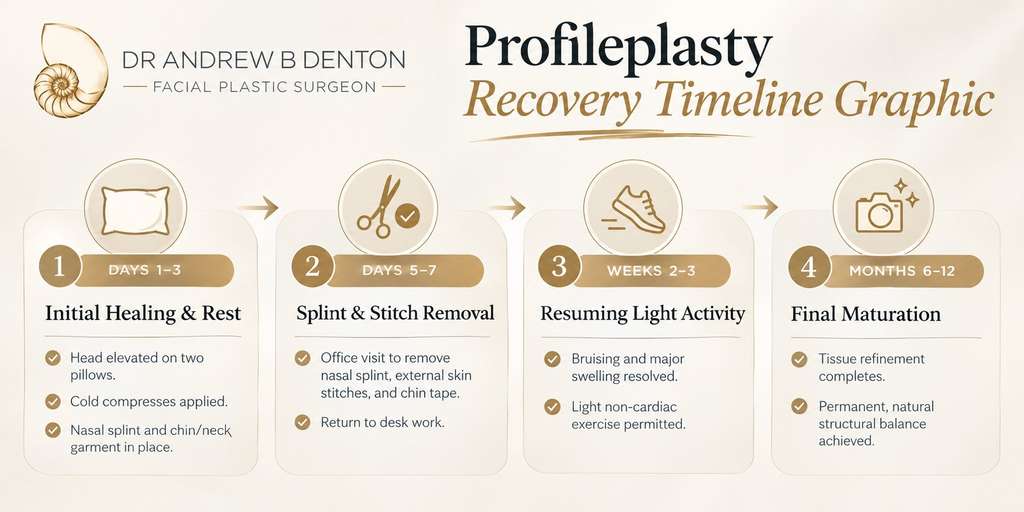
From a practical standpoint, bundling procedures during a single surgical session offers significant cost savings. Patients pay facility fees, anesthesia charges, and pre-operative testing expenses only once, making profileplasty far more economical than scheduling separate operations months apart.
Choosing the Right Surgeon
Selecting a qualified specialist for rhinoplasty and profileplasty is the most critical decision in your surgical journey. Because the face possesses intricate vascular networks, delicate nerves, and complex cartilage dynamics, choosing a surgeon who focuses exclusively on facial plastic surgery ensures the highest standard of care.
Surgeon Selection Checklist
- Board Certification: Verify certification with recognized bodies like the Royal College of Physicians and Surgeons of Canada or the American Board of Facial Plastic and Reconstructive Surgery.
- Facial-Only Specialization: Ensure the surgeon’s practice focuses entirely on head and neck procedures rather than general body plastic surgery.
- Accredited Facility: Confirm that surgery will occur in a government-licensed or college-accredited non-hospital surgical facility.
- Proven Results: Review an extensive portfolio of actual patient before-and-after photographs demonstrating natural-looking profile outcomes.
Patients should exercise caution regarding discount cosmetic surgery or offshore medical tourism. Correcting botched nasal or facial procedures is vastly more complex, expensive, and emotionally draining than ensuring proper execution during your primary surgery.
Costs and Considerations in Vancouver
Cost varies based on whether a patient chooses rhinoplasty alone or a combined profileplasty approach, since combined procedures involve additional surgical and anesthesia time. During your consultation, you will receive a detailed, itemized quote specific to your anatomy and goals rather than a generic estimate, since no two rhinoplasty and profileplasty plans are identical.
Frequently Asked Questions
Is a profileplasty performed during a single surgery?
Yes. A profileplasty combines nasal reshaping with chin augmentation or neck contouring during one surgical session. Performing these together requires only one administration of twilight anesthesia and a single recovery window.
Will a chin implant look or feel unnatural?
Modern solid silicone chin implants are designed to mimic natural bone density and contours. Placed precisely over the jawbone through a small incision, the implant remains stable, permanent, and undetectable to touch or sight.
How do I know if I need a chin implant or just a nose job?
High-resolution computer imaging during your consultation visually clarifies your facial proportions. If a recessed chin makes a normal nose appear artificially prominent, adding chin augmentation provides proper profile balance.
What is the age requirement for combined profile procedures?
Patients should be at least eighteen years old so that facial bone development is complete. Candidates of any adult age in good health can undergo profile balancing to refine genetic traits or age-related changes.
How long do the results of a profileplasty last?
Both rhinoplasty and surgical chin implants offer permanent structural enhancements. While facial soft tissues continue to age naturally over time, the underlying structural refinements established by surgery remain permanently in place.
Is recovery harder for combined profileplasty than rhinoplasty alone?
Recovery is surprisingly similar because chin implant incisions heal quickly with minimal discomfort. Patients generally return to work and light daily routines within seven to ten days following combined surgery.
How do I choose between rhinoplasty and profileplasty?
Choosing between rhinoplasty and profileplasty depends on whether your aesthetic concerns are isolated to the nose or involve chin projection and jawline definition. Computer imaging during consultation clearly illustrates which approach achieves true harmony.
Can I have rhinoplasty now and add chin surgery later?
Yes, staged surgery is possible. However, planning rhinoplasty and profileplasty together often gives a more predictable final proportion, since the surgeon can design both changes with the final relationship in mind.
Schedule Your Profile Consultation Today
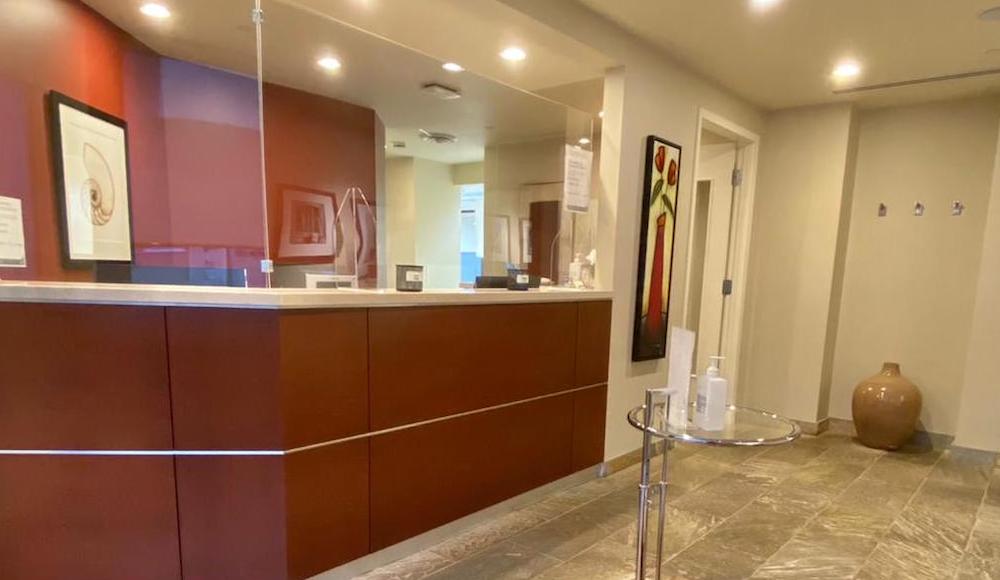
If you are considering facial rejuvenation and want to understand whether rhinoplasty and profileplasty is right for your unique features, Dr Denton invites you to schedule a private consultation at our Vancouver clinic. Together, we will evaluate your profile using advanced digital computer imaging, explore your goals in an unhurried environment, and establish a personalized treatment plan designed to achieve natural, enduring facial harmony.
Align your outward appearance with your inner confidence.
Contact Dr Andrew B. Denton Today:
- Phone: (604) 879-3223
- Address: Suite 202 – 943 West Broadway, Vancouver, BC V5Z 4E1
- Online Consultation: doctordenton.com/consultation
Located conveniently in the heart of Vancouver’s medical corridor, just one block from Vancouver General Hospital.