
The Power of Strategic Combination
When you look in the mirror and notice a specific sign of ageing, such as heavy upper eyelids or sagging skin along the jawline, your first instinct might be to seek a single, isolated fix. However, facial ageing is rarely a localized event. It is a synchronized process that affects the bone structure, muscle tone, and skin elasticity across the entire head and neck. As an experienced facial plastic surgeon in Vancouver, Dr Andrew Denton has found that addressing only one concern while ignoring surrounding areas can sometimes lead to an unbalanced or unnatural appearance.
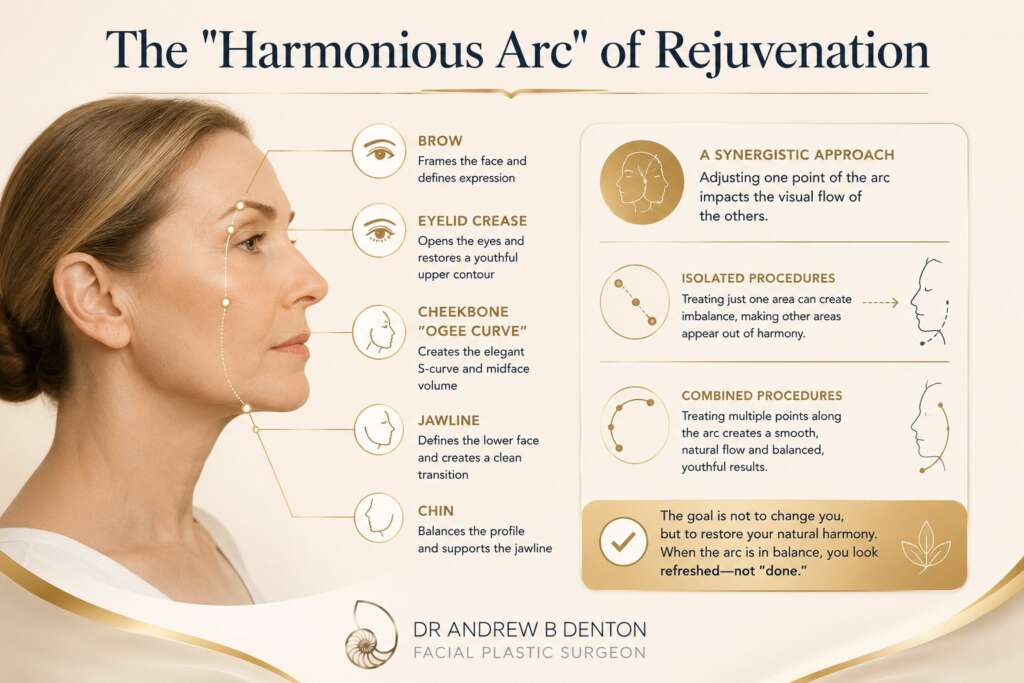
The modern approach to aesthetic medicine focuses on harmony and proportion. This is why combining facial plastic surgery procedures has become the preferred strategy for patients seeking comprehensive rejuvenation. By planning multiple corrections simultaneously, we can ensure that the forehead, eyes, mid-face, and neck all age at the same visual rate, producing a result that looks refreshed rather than “operated on.”
During his 25 years of experience, Dr Denton has found that patients often don’t realise how many procedures can be safely paired together, or how much planning goes into deciding what belongs in the same operation and what doesn’t. This guide walks you through which procedures pair well, how we plan combined facial plastic surgery procedures, what the recovery actually looks like, and what questions to bring to your consultation. Our goal is to give you a clear, honest picture so you can make a confident decision about your own rejuvenation plan.
Why Combine Facial Procedures?
When patients ask us whether combining facial plastic surgery procedures makes sense for them, Dr Denton usually starts with the idea of facial harmony. Ageing rarely affects just one area. The brows drop, the eyelids develop excess skin, the midface loses volume, and the jawline and neck lose definition, often all around the same time. If Dr Denton lifts only the lower face and leaves heavy brows untouched, the results can look mismatched rather than refreshed. Addressing the face as a connected unit, instead of one region at a time, tends to produce a more balanced facial rejuvenation combination.
Dr Denton believes that informed patients make the best decisions, which is why his practice is built around the philosophy that you are an equal member of the decision-making team. During a consultation at our Vancouver facial plastic clinic, West Coast Cosmetic Surgery Centre, we don’t just look at wrinkles; we evaluate the structural integrity of your entire profile.
We utilize high-resolution computer imaging to facilitate this planning process. This technology allows you to visualize proposed changes on your own digital photograph, helping you understand how a rhinoplasty might necessitate a chin implant for profile balance, or how a facelift achieves its best results when paired with a neck lift.
There’s also a practical case to be made. Here’s what tends to matter most to patients weighing their options:
- One recovery instead of several: Rather than healing from a brow lift this year and a facelift with eyelid surgery next year, you go through downtime once.
- Cost efficiency: Combining procedures means one anaesthesia fee, one facility fee, and one block of time away from work, rather than paying those costs multiple times over.
- Fewer anaesthesia exposures: Each general anaesthetic carries its own set of risks. Reducing the total number of times you go under anaesthesia, while staying within safe combined facial procedures guidelines, can lower your overall cumulative exposure.
- Less prolonged uncertainty: Many patients tell me that having one clear surgical plan and one recovery timeline feels far less stressful than an ongoing series of separate procedures spread across years.
None of this means combining facial plastic surgery procedures is right for everyone or every pairing. Patient candidacy still depends on health status, the scope of surgery being considered, and realistic expectations. But for the right candidate, a thoughtfully sequenced combination often produces results that feel more complete than staged, standalone surgeries ever could.
Most Common and Effective Combinations
Certain combinations of facial plastic surgery procedures come up again and again in our practice because the anatomy and ageing patterns of these regions naturally overlap. Below is a breakdown by facial zone, followed by a summary table.
Upper Third: Brow Lift + Upper Blepharoplasty
Heavy or descended brows and excess upper eyelid skin frequently occur together, and treating only one can leave the other concern more noticeable. A brow lift and blepharoplasty performed in the same session lifts the eyebrow position while removing excess eyelid skin, giving a more open, rested appearance to the eyes. A large multicenter analysis of over 6,000 aesthetic eye surgery patients found that major complication rates for combined brow lift and blepharoplasty were statistically similar to blepharoplasty alone, at roughly 0.4 percent for both groups, with brow lift alone showing a slightly higher rate of 0.7 percent, and hematoma, the most common complication, occurred at comparable rates across all three groups. This is one of the more reassuring data points for patients who are nervous about the safety of pairing these two procedures.
Midface: Facelift + Midface Lift or Fat Grafting
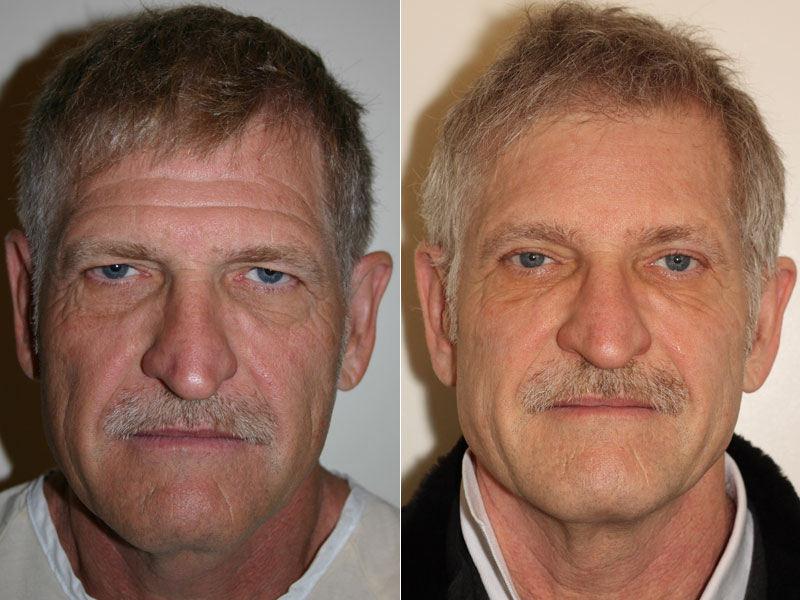
A deep-plane facelift addresses skin laxity and descent, but it doesn’t restore lost volume on its own. Pairing a comprehensive facelift with fat grafting fills hollowed cheeks and temples while the lift repositions sagging tissue, producing a result that looks rested rather than simply pulled. Facelift combined with lower blepharoplasty is another frequent pairing since it creates a seamless transition between the cheek and lower eyelid rather than leaving a visible line between treated and untreated areas.
Lower Face & Neck: Facelift + Neck Lift
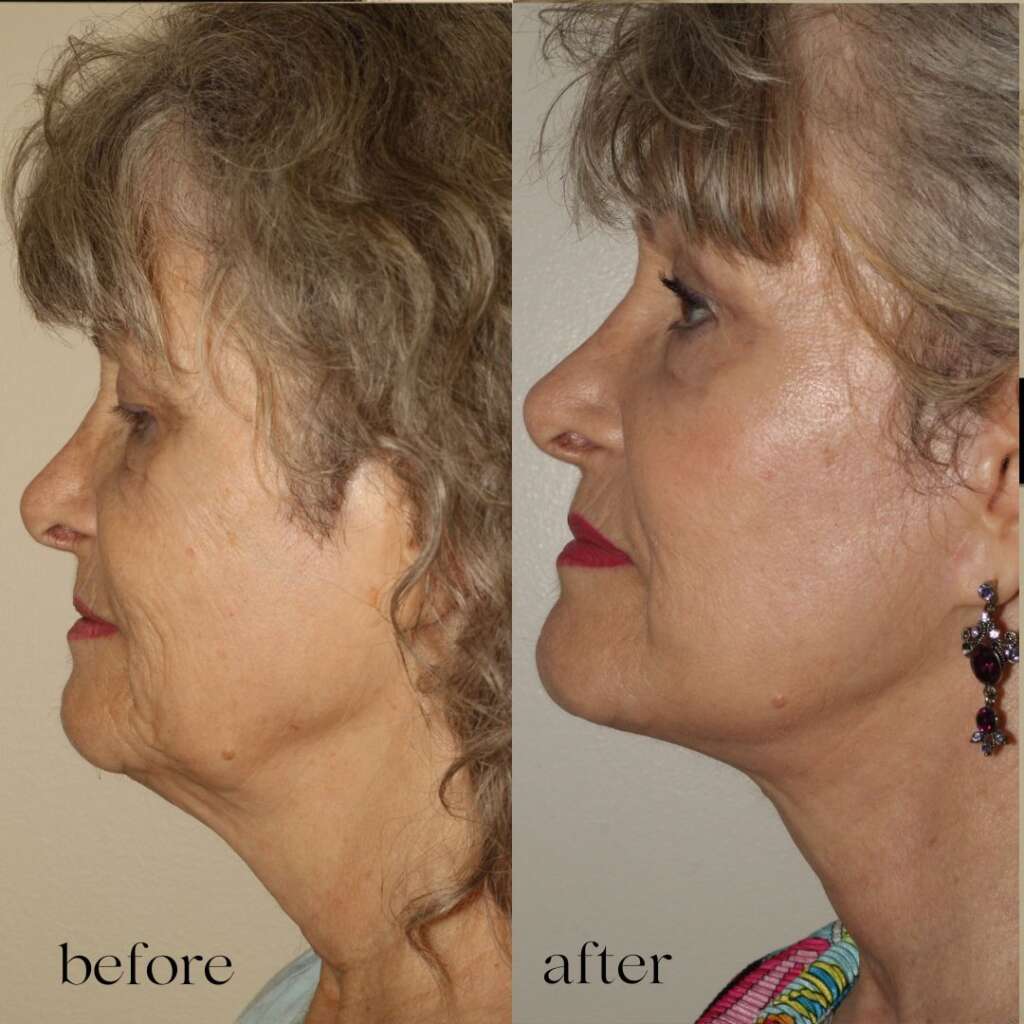
This is likely the combination facial plastic surgeons perform most often. A facelift with neck lift and platysmaplasty addresses jowling, loose neck skin, and vertical neck banding together, often paired with liposuction or submental contouring to refine the area beneath the chin. Because the lower face and neck share the same underlying muscle layer, the platysma, treating them separately can leave a visible mismatch between a tightened jawline and an unaddressed neck.
Balancing the Profile: Rhinoplasty and Chin Augmentation
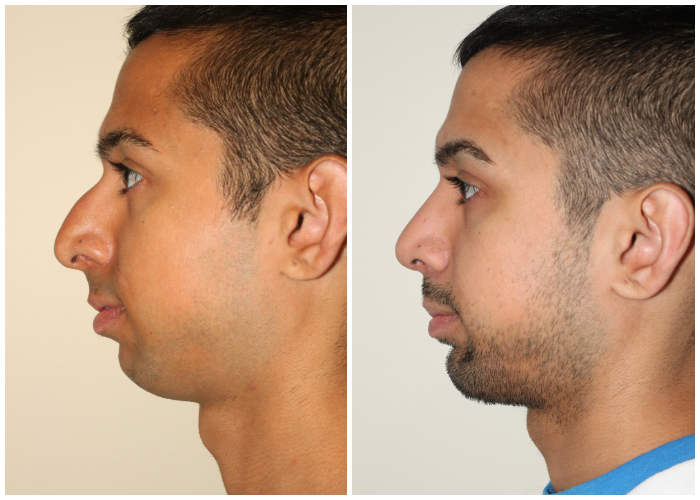
One of the most frequently performed combinations is the pairing of nose reshaping with chin augmentation. A nose may appear disproportionately large simply because the chin is recessed or weak. By placing a biocompatible silicone chin implant at the same time as a rhinoplasty, Dr Denton can create a more balanced and elegant profile. This combination addresses the “anchor” points of the face, ensuring that the new nasal shape complements the lower facial structure.
Total Frame Refinement: Facelifts Combined with Ear Procedures
When we perform a facelift at our Vancouver clinic, the goal is a smooth, youthful transition from mid-face to neck, but the ears frame that transformation, and protruding ears or elongated, thin earlobes can distract from otherwise rejuvenated contours, which is why combining a facelift with otoplasty or earlobe repair to address both the frame and the central features in one session.
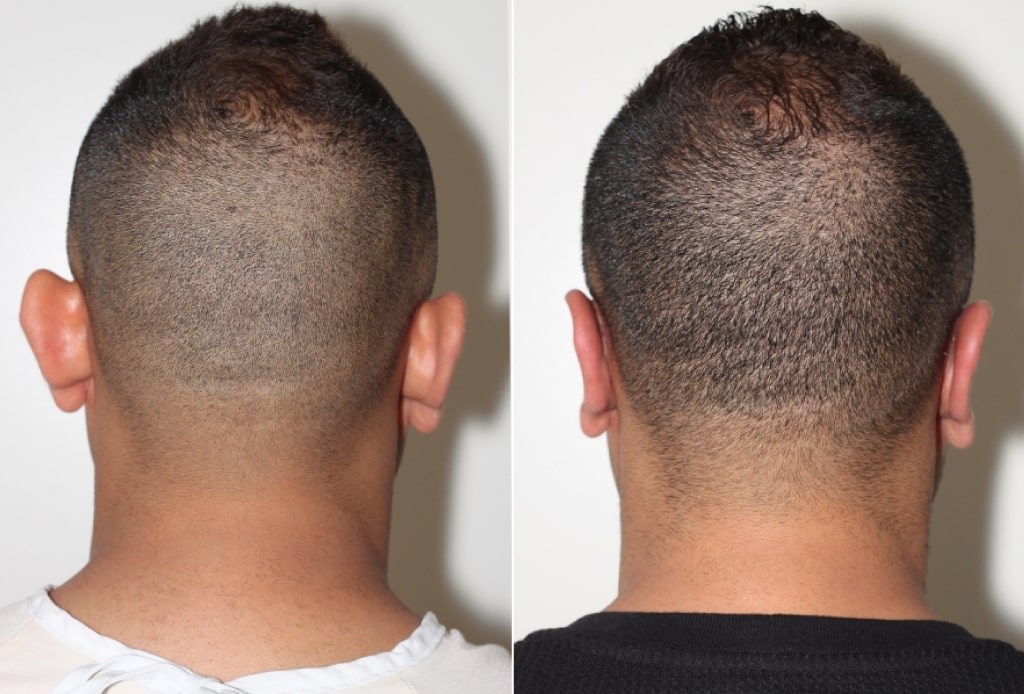
This works especially well because facelift incisions are already hidden within the natural creases around the ear, so those same access points can be used to refine the ear’s shape or position without additional scarring. Stretched or heavy earlobes are a common, often-overlooked sign of aging that becomes obvious once the jawline is tightened; Dr Denton can perform a loboplasty in under an hour to restore a more youthful, rounded lobe. Similarly, otoplasty can bring prominent ears closer to the head, typically within two centimeters, correcting a structural imbalance no facelift alone can fix. Refining these anchor points keeps the whole profile in balance, and our team uses computer imaging during consultations so patients can see exactly how these combined changes will harmonize before moving forward.
Common Procedure Combinations by Facial Zone
| Facial Zone | Combination | Primary Benefit | Typical Candidacy |
| Upper Third | Brow lift + upper blepharoplasty | Corrects hooded lids and low brows together | Low brow position + excess eyelid skin |
| Midface | Deep-plane facelift + fat grafting | Restores volume while tightening | Midface volume loss + laxity |
| Midface | Facelift + lower blepharoplasty | Seamless cheek-to-eyelid transition | Lower lid bags + jowling |
| Lower Face & Neck | Facelift + neck lift + platysmaplasty | Comprehensive jawline and neck definition | Neck banding + jawline laxity |
| Profile Balance | Rhinoplasty + chin augmentation | Balances facial proportions | Weak chin + dorsal hump |
Strategic Planning: The Patient Journey
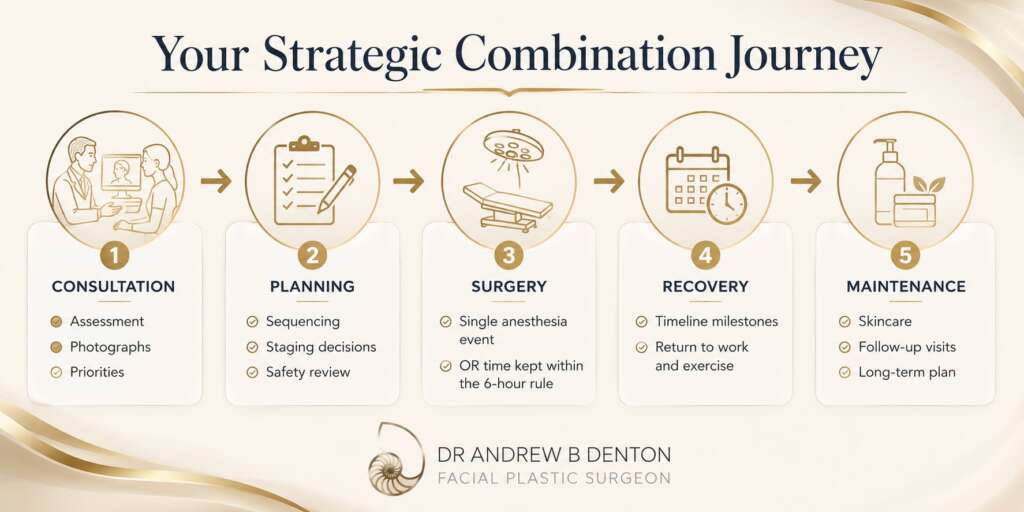
Combining facial plastic surgery procedures is not a decision we make in the first five minutes of a consultation. It develops through a structured process that I walk through with every patient considering more than one procedure.
Consultation and Assessment
We start by listening to what bothers you most, then examine your face as a whole, not just the region you mention first. Photographs, skin quality, bone structure, and prior surgical history all factor into this assessment.
Prioritization
Not every concern needs to be addressed in the same session. I help patients rank their concerns so we can decide what belongs in this surgery and what might be reasonable to defer.
Sequencing Logic
Some procedures work better performed in a specific order within the same operation. For example, volume restoration through fat grafting is often planned around the facelift’s tissue repositioning, not as an afterthought.
Staging Versus Combining
If a patient’s health status, the scope of desired changes, or safe operating time limits argue against combining everything into one session, I recommend staging procedures across two surgeries instead. This is a safety decision, not a sales decision.
Customization
No two faces age the same way, so no two surgical plans should look identical. What works for one patient’s combination of concerns may not suit another’s anatomy or goals.
Safety Considerations and Candidacy
The question we hear most often about combining facial plastic surgery procedures is whether it is safe to combine facelift and eyelid surgery, or any other pairing, into one operation. The honest answer is that safety depends far less on the number of procedures and far more on how the combination is planned.
The 6-Hour Rule
Most experienced surgeons work within a general guideline that total anesthesia time should not exceed roughly six hours for elective aesthetic surgery, since surgeons broadly agree there is a time limit patients should remain under anesthesia, and understanding that limit allows for a strategic plan tailored to each individual. Operating time beyond this window is linked to a measurably higher risk of complications such as blood clots, so I plan every combined case with this ceiling in mind, sometimes staging additional procedures into a second session rather than pushing past it.
Patient Health Criteria
Good candidates for combined procedures are generally in stable health, at a healthy weight, free of uncontrolled medical conditions, and non-smokers, since smoking impairs healing and raises complication risk across the board.
Complication Rates
Research specific to combined facial procedures is reassuring. As mentioned earlier, the multicenter study on brow lift and blepharoplasty found no meaningful increase in major complications when the two were performed together compared with either procedure alone, with rates around 0.4 percent for the combined group. In experienced hands, combining facial plastic surgery procedures does not appear to carry dramatically higher risk than performing the individual procedures separately.
Risks to Disclose
Every surgery carries some risk of bleeding, infection, scarring, asymmetry, or a need for revision. Combining procedures does not eliminate these risks, and responsible facial plastic surgeons discuss each of them during consultations rather than glossing over them.
Medication Management
Blood thinners, certain supplements, and some medications need to be paused before surgery. Your surgeon should review your full medication list carefully as part of candidacy screening for any combined procedure.
Recovery Timeline and What to Expect
A primary concern for many patients considering combining facial plastic surgery procedures is the recovery period. While it may seem daunting to undergo multiple procedures at once, it is often more efficient from a healing perspective.
- A Single Recovery Window: Instead of taking two weeks off work for a facelift and then another week off later for an eyelid lift, you consolidate your downtime. Most patients can return to non-strenuous activities within ten to fourteen days, regardless of whether they had one or three procedures.
- Reduced Physiological Stress: Undergoing anesthesia once is easier on the body than multiple separate sessions. Dr. Denton utilizes twilight anesthesia (procedural sedation) whenever possible. This method allows you to sleep deeply without the aid of a breathing tube, resulting in less bleeding, less bruising, and a faster return to normal life.
- Consistent Results: Healing from combined procedures ensures that all treated areas settle and “mature” at the same time, providing a more uniform transition to your new look.
Single vs. Combined Procedure Recovery Comparison
| Recovery Milestone | Single Procedure (e.g., Eyelid Lift) | Combined Procedure (e.g., Facelift + Eyelid) |
| Primary Swelling/Bruising | 7 to 10 days | 10 to 14 days |
| Return to Desk Work | 5 to 7 days | 10 to 14 days |
| Light Exercise | 2 weeks | 2 to 3 weeks |
| Total Recovery Periods | Multiple sessions | One session |
Financial and Practical Advantages
While the upfront cost of multiple procedures is higher, combining facial plastic surgery procedures is significantly more cost-effective in the long run.
- Facility and Anaesthesia Fees: Every surgical session requires a fee for the accredited surgical facility and the anaesthesia team. By bundling procedures, you only pay these administrative and overhead costs once.
- Pre-operative Expenses: Combined surgery reduces the number of required blood tests, physical exams, and post-operative medications you need to purchase.
- Professional Longevity: For many Vancouver professionals, the most significant “cost” is time away from the office. Consolidation minimizes professional disruption.
Why Choose Dr Andrew Denton for Your Multi-Procedure Plan?
Performing multiple facial surgeries simultaneously requires a high degree of technical precision and an artistic eye for overall facial balance. Dr Denton is a board-certified facial plastic surgeon who has focused his practice exclusively on the complex anatomy of the head and neck for 25 years.

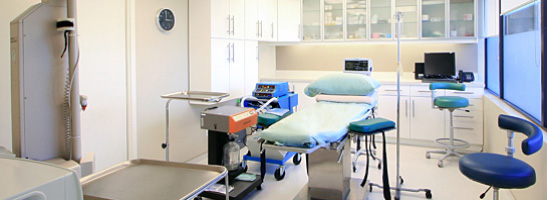
As an Assistant Clinical Professor at the University of British Columbia, he remains at the forefront of surgical research and education. All procedures are performed in our fully accredited private surgical facility, located conveniently in the heart of Vancouver’s medical corridor. This state-of-the-art suite meets the highest standards of safety and hygiene, ensuring your journey is as comfortable as it is transformative.
Non-Surgical Enhancements: The Final Touch
Strategic planning doesn’t end with surgery. Dr Denton often recommends non-surgical treatments to complement surgical results. For example, while a facelift tightens the skin and muscle, it does not address the fine lines caused by repetitive expressions or sun damage.
By adding Botox to your post-operative regimen, you can smooth “crow’s feet” around the eyes or frown lines on the forehead. Dermal fillers like Juvederm can be used to add subtle volume to the lips or temples, areas that surgery alone might not fully address. This combination of surgical structure and non-surgical refinement represents the pinnacle of modern facial rejuvenation.
FAQs
Can I combine a facelift with eyelid surgery?
Yes, facelift with eyelid surgery is one of the most common combinations in facial plastic surgery. It addresses lower face laxity and periorbital ageing together, producing more harmonious, natural-looking results than treating either area alone in separate sessions.
How long is recovery for combined facial procedures?
Most patients see peak swelling in the first three days, suture removal around day ten, and return to work within two to three weeks. Recovery is not additive. It typically mirrors the timeline of your single longest procedure.
What’s the maximum safe surgery time?
Most experienced surgeons follow a general 6-hour rule for total anaesthesia time in elective facial surgery. Operating beyond this window is linked to higher complication risk, so procedures exceeding it are usually staged across two separate sessions instead.
Will combining procedures increase my risk?
Not necessarily. Research on combined brow lift and blepharoplasty shows complication rates comparable to single procedures performed alone. Risk depends more on total surgical time, patient health, and surgeon experience than on the number of procedures combined.
Will I look like a different person if I combine procedures?
The goal is never to change who you are, but to restore a more youthful version of yourself. By addressing multiple areas, Dr Denton ensures that your features remain in balance, avoiding the “operated” look that occurs when only one area is tightened.
How do I know which procedures I should combine?
This is determined during your unhurried consultation. We use computer imaging to show you the expected results of various combinations, allowing you to see how different procedures work together to achieve your specific aesthetic goals.
How long do the results of combined procedures last?
Surgical results like those from a SMAS facelift or rhinoplasty are long-lasting, often remaining effective for seven to ten years or more. While you will continue to age naturally, you will always look younger than you would have without the surgery.
Your Next Step Toward Comprehensive Rejuvenation
A strategic combination of facial procedures, when planned carefully around your health, anatomy, and goals, offers a path to harmonious, long-lasting results with a single, coordinated recovery. Rather than chasing one concern at a time, treating the face as a connected whole tends to produce results that look more natural and cohesive.
If you’re weighing your own options, from a facelift with eyelid surgery to a brow lift and blepharoplasty, or a fuller combination involving the neck and midface, we invite you to schedule a consultation. Dr Denton and his dedicated team at the West Coast Cosmetic Surgery Centre to guide you through every step of your transformation.
Explore more on our facelift, blepharoplasty, brow lift, and before and after gallery pages to see the kind of results a coordinated approach can achieve.
Align your outward reflection with your inner vitality. Book your confidential consultation with Dr Denton today and take the first step toward comprehensive, natural-looking results.